DRIVINGO
Road signs
Yellow and Red Lines: What Single, Double and Red Route Markings Mean
Published
Double yellow lines ban waiting around the clock, and a single yellow line means no waiting during the hours shown on a nearby plate. Red lines go one step further: on a red route they mean you may not stop at all, not even for a moment, unless a sign or a marked box says otherwise. Yellow marks on the kerb are a separate control again, and they are about loading rather than parking.
The colours are easy to remember once you see the pattern. Yellow controls waiting, red controls stopping, and the more paint there is, the stricter the rule. The theory test asks about each of them, and about the zig-zag lines that keep crossings and school gates clear. Here is each marking against the Highway Code rule behind it.
What do the lines along the kerb mean?
| Marking | What it means |
|---|---|
| Double yellow lines | No waiting, day or night, even with no sign |
| Single yellow line | No waiting during the times on the nearby plate or zone entry sign |
| Double red lines | Red route: no stopping, day or night |
| Single red line | Red route: no stopping during the times on the nearby sign |
| Two yellow marks on the kerb | No loading or unloading at any time |
| One yellow mark on the kerb | No loading or unloading during the times shown |
| Zig-zag lines at a crossing | No parking, no stopping and no overtaking the lead vehicle |
| Yellow zig-zags outside a school | Keep the entrance clear, even to drop children off |
The rest of this article is those rows in detail.
What do double yellow lines mean?
No waiting, ever. Double yellow lines are the one waiting restriction that needs no sign beside it: the paint alone tells you the ban applies around the clock, every day of the week.
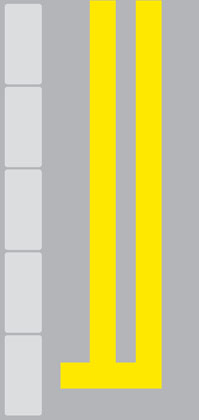
The Highway Code covers both yellow markings in a single rule, and it is the one to learn for this topic.
The Highway Code, Rule 238: You MUST NOT wait or park on yellow lines during the times of operation shown on nearby time plates (or zone entry signs if in a Controlled Parking Zone) – see ‘Traffic signs’ and ‘Road markings’. Double yellow lines indicate a prohibition of waiting at any time even if there are no upright signs. You MUST NOT wait or park, or stop to set down and pick up passengers, on school entrance markings (see ‘Road markings’) when upright signs indicate a prohibition of stopping. Law RTRA sects 5 & 8
"Waiting" is the key word, and it is not the same as loading. The Highway Code treats loading separately, which is why the kerb marks further down exist.
What does a single yellow line mean?
No waiting during the times shown on a nearby plate. Outside those times you may usually park on it. The plate is a small upright sign on a post or wall near the line, and it gives the days and hours the restriction applies.
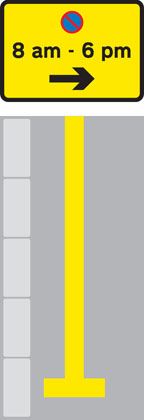
If you cannot find a plate, look for a zone entry sign on the way in. In a Controlled Parking Zone the times are given once, at the entrance to the zone, rather than on every street.
The Highway Code, Rule 245: Controlled Parking Zones. The zone entry signs indicate the times when the waiting restrictions within the zone are in force. Parking may be allowed in some places at other times. Otherwise parking will be within separately signed and marked bays.
So the hours that apply to a single yellow line in a zone are whatever the entry sign said as you drove in. That is easy to miss when you have turned in from a main road, and it is the reason the zone exists: one set of times for a whole area instead of a plate on every lamp post.
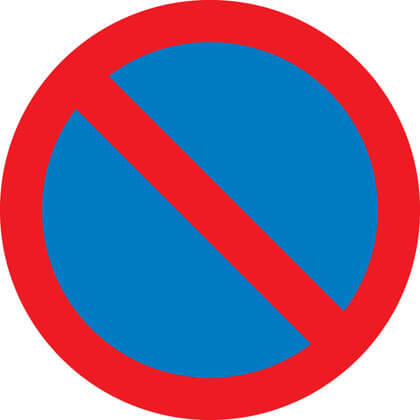
The round blue sign with a single red diagonal is the upright version of the same message: no waiting. It is a circular sign with a red ring, so it gives an order. Our guide to road sign shapes explains how the shape tells you whether a sign orders, warns or informs.
What are red routes, and what do red lines mean?
A red route is a main road where stopping is banned, and the red lines along its edge show when. With double red lines the ban runs around the clock; with a single red line it applies only during the hours on the nearby sign. Red routes are found on busy main roads in cities, and they are stricter than yellow lines: yellow lines stop you waiting, red lines stop you stopping.
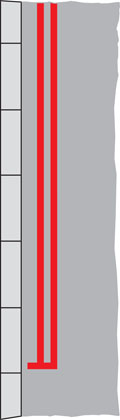
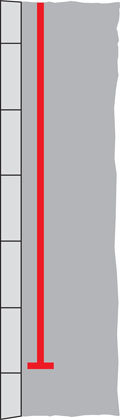
The ban sits in the Highway Code's list of places where you must not stop or park, which is also the rule for clearways and the zig-zags covered below.
The Highway Code, Rule 240: You MUST NOT stop or park on
- the carriageway, an emergency area or a hard shoulder of a motorway except in an emergency (see Rules 270 and 271)
- a pedestrian crossing, including the area marked by the zig-zag lines (see Rule 191)
- a clearway (see Traffic signs)
- taxi bays as indicated by upright signs and markings
- an urban clearway within its hours of operation, except to pick up or set down passengers (see Traffic signs)
- a road marked with double white lines, even when a broken white line is on your side of the road, except to pick up or set down passengers, or to load or unload goods
- a tram or cycle lane during its period of operation
- a cycle track
- red lines, in the case of specially designated ‘red routes’, unless otherwise indicated by signs. Any vehicle may enter a bus lane to stop, load or unload where this is not prohibited (see Rule 141).
Laws MT(E&W)R regs 7 & 9 as amended by MT(E&W)(A)(E)R, MT(S)R regs 6 & 8, RTRA sects 5, 6 and 8, TSRGD schedule 7 parts 2, 3, 4, 5 and 7, schedule 9 part 6, schedule 14 parts 1 and 5
Notice the closing words of the red-lines entry: unless signs say otherwise. Red routes are not solid no-stopping zones from end to end. Marked boxes along the kerb show where you may park or load, and the sign beside each box says when and for how long.
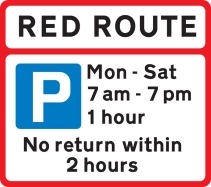
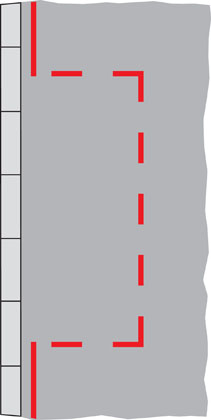
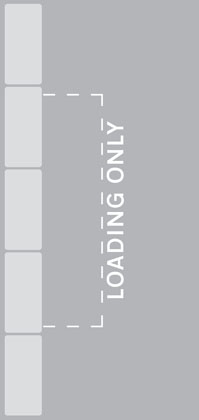
A loading box like this one allows loading only, at the times shown and for up to 20 minutes. Read the sign every time, because two boxes on the same road can carry different times.
What do the yellow marks on the kerb mean?
They restrict loading and unloading. Short yellow dashes painted across the top of the kerb are separate from the lines in the road. Two marks mean no loading or unloading at any time; one mark means no loading or unloading during the times on the nearby plate.
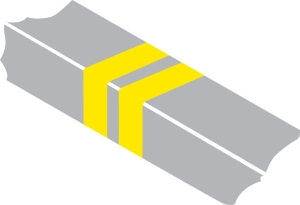
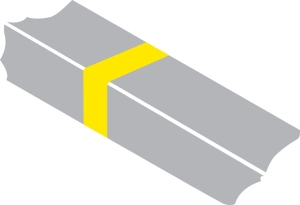
The Highway Code, Rule 247: Loading and unloading. Do not load or unload where there are yellow markings on the kerb and upright signs advise restrictions are in place (see ‘Road markings’). This may be permitted where parking is otherwise restricted. On red routes, specially marked and signed bays indicate where and when loading and unloading is permitted. Law RTRA sects 5 & 8
The second sentence of that rule is the one people get wrong. Loading may be allowed where parking is not, so a van can often load or unload on yellow lines provided there are no kerb marks banning it. On a red route the position is reversed: loading happens only in the marked bays, and only when the sign beside them allows it.
Where a street has a dedicated loading bay, it is marked in the road and signed, and it is for loading only.
What do zig-zag lines at a crossing mean?
No parking, no stopping, and no overtaking the vehicle at the front. The white zig-zags on each side of a zebra or signal-controlled crossing protect the view between drivers and the people waiting to cross. A parked car there would hide a child stepping out.
The Highway Code, Rule 191: You MUST NOT park on a crossing or in the area covered by the zig-zag lines. You MUST NOT overtake the moving vehicle nearest the crossing or the vehicle nearest the crossing which has stopped to give way to pedestrians. Laws RTRA sect 25(5) & TSRGD schedule 14 parts 1 and 5
The ban on stopping on the zig-zags also appears in the list in Rule 240 above, so it is a legal requirement, not advice. Our guide to zebra, pelican, puffin and toucan crossings covers the crossings themselves and what each set of lights means.
What do the yellow zig-zags outside a school mean?
Keep the entrance clear of stopped vehicles, even if you are only dropping off or picking up children. The yellow zig-zag marking with the words SCHOOL KEEP CLEAR stops parked cars from hiding children as they come out of the gate.

Rule 238 above makes the marking enforceable when there is an upright sign beside it showing a ban on stopping. Even where there is none, the Highway Code tells you to keep away from the school gate altogether when stopping or parking.
The Highway Code, Rule 243: DO NOT stop or park:
- near a school entrance
- anywhere you would prevent access for Emergency Services
- at or near a bus or tram stop or taxi rank
- on the approach to a level crossing/tramway crossing
- opposite or within 10 metres (32 feet) of a junction, except in an authorised parking space
- near the brow of a hill or hump bridge
- opposite a traffic island or (if this would cause an obstruction) another parked vehicle
- where you would force other traffic to enter a tram lane
- where the kerb has been lowered to help wheelchair users and powered mobility vehicles
- in front of an entrance to a property
- on a bend
- where you would obstruct cyclists’ use of cycle facilities
except when forced to do so by stationary traffic. In Scotland you MUST NOT double park or park anywhere the kerb has been lowered to help pedestrians or cyclists. Exceptions are allowed in limited circumstances. Law T(Scot)A part 6
That rule also carries two distances and places that come up in questions: not within 10 metres of a junction unless you are in an authorised space, and not where the kerb has been lowered to help wheelchair and mobility scooter users.
What is a clearway?
A road where you must not stop on the main carriageway at all. It is signed rather than painted, with a round blue sign crossed by a red X.
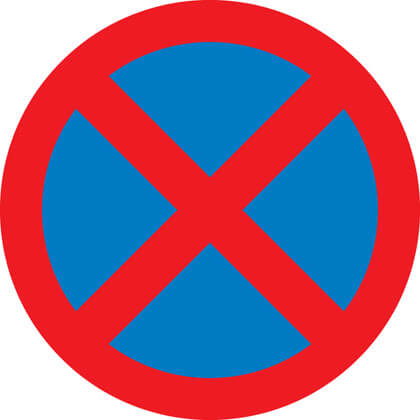
An urban clearway is a version that applies only during its hours of operation, and it carries one exception: you may stop just long enough to let passengers in or out. Both are in the Rule 240 list above.
Are the yellow criss-cross lines at a junction a parking marking?
No. They mark a box junction, and they control moving traffic. You must not enter the box until your exit is clear. The one exception is turning right, when you may wait in the box if oncoming traffic, or other vehicles turning right, are all that is stopping you.
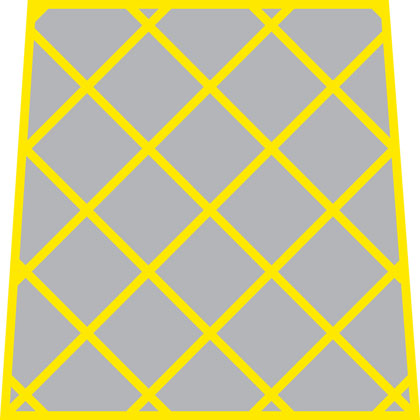
The Highway Code, Rule 174: Box junctions. These have criss-cross yellow lines painted on the road (see ‘Road markings’). You MUST NOT enter the box until your exit road or lane is clear. However, you may enter the box and wait when you want to turn right, and are only stopped from doing so by oncoming traffic, or by other vehicles waiting to turn right. At signalled roundabouts you MUST NOT enter the box unless you can cross over it completely without stopping. Law TSRGD schedule 9 parts 7 and 8
They are yellow, so they get mixed up with yellow lines in questions, but the rule behind them is about keeping a junction moving rather than about where you may park.
Yellow and red lines in the theory test
Across the four question banks in the Drivingo app, 22 questions ask about yellow lines, red routes, clearways or zig-zags by name: 8 in the car bank, 6 in motorcycle, 5 in LGV/PCV and 3 in ADI. Many more show a picture of a marking and ask what it means. The patterns repeat:
- what a single yellow line allows, and when
- what double red lines mean, and what a red route bans
- when you may stop on a clearway or an urban clearway
- what the yellow zig-zags outside a school mean, and whether you may drop children off on them
- whether you may park on the zig-zags at a crossing
- what happens in a controlled parking zone
The lorry and bus banks lean on loading, because a delivery driver meets kerb marks and red-route loading boxes every day. The zig-zag questions overlap with the hierarchy of road users, since both are about protecting the people most at risk near a crossing.
Drivingo drills every road marking question in its practice banks, with explanations that tie each answer back to its Highway Code rule, and the full Code reads offline inside the app. Download Drivingo and make yellow and red lines a topic you get right without thinking.
Contains public sector information licensed under the Open Government Licence v3.0.