DRIVINGO
Theory test
The Hierarchy of Road Users: What Rules H1, H2 and H3 Mean
Published
What is the hierarchy of road users?
The hierarchy of road users is the principle that whoever can cause the most harm carries the most responsibility for avoiding it. It sits at the very front of the Highway Code as three lettered rules — H1, H2 and H3 — added in the 2022 update, before Rule 1 and before anything about signs, junctions or speed.
The order runs from those most at risk to those posing most danger: pedestrians first, then cyclists, horse riders, motorcyclists, cars, vans, and finally large goods and passenger vehicles. A lorry driver owes more care to a cyclist than the cyclist owes the lorry.
The Highway Code, Rule H1: It is important that ALL road users are aware of The Highway Code, are considerate to other road users and understand their responsibility for the safety of others. Everyone suffers when road collisions occur, whether they are physically injured or not. But those in charge of vehicles that can cause the greatest harm in the event of a collision bear the greatest responsibility to take care and reduce the danger they pose to others. This principle applies most strongly to drivers of large goods and passenger vehicles, vans/minibuses, cars/taxis and motorcycles. Cyclists, horse riders and drivers of horse drawn vehicles likewise have a responsibility to reduce danger to pedestrians. None of this detracts from the responsibility of ALL road users, including pedestrians, cyclists and horse riders, to have regard for their own and other road users’ safety. Always remember that the people you encounter may have impaired sight, hearing or mobility and that this may not be obvious.
Does the hierarchy mean pedestrians always have right of way?
No, and this is the single most common misunderstanding of it.
The hierarchy is about responsibility, not priority. It does not hand anyone a free pass, and Rule H1 is explicit that it does not remove the responsibility of any road user to look after their own safety. A pedestrian stepping into the road without looking is still behaving dangerously, and a cyclist jumping a red light is still in the wrong.
What the hierarchy changes is the standard expected of whoever is driving the heavier thing. Being in the right does not discharge you from taking care. That distinction is exactly what test questions on this topic probe, so it is worth holding onto.
When must I give way to pedestrians at a junction?
When they are crossing or waiting to cross the road you are turning into or out of. This is Rule H2, and it is the change that caught out the most experienced drivers, because it reversed a habit built over decades: waiting for the pedestrian rather than expecting them to wait for you.
The Highway Code, Rule H2: At a junction you should give way to pedestrians crossing or waiting to cross a road into which or from which you are turning. You MUST give way to pedestrians on a zebra crossing, and to pedestrians and cyclists on a parallel crossing (see Rule 195). Pedestrians have priority when on a zebra crossing, on a parallel crossing or at light controlled crossings when they have a green signal. You should give way to pedestrians waiting to cross a zebra crossing, and to pedestrians and cyclists waiting to cross a parallel crossing. Horse riders should also give way to pedestrians on a zebra crossing, and to pedestrians and cyclists on a parallel crossing. Cyclists should give way to pedestrians on shared use cycle tracks and to horse riders on bridleways. Only pedestrians may use the pavement. Pedestrians include wheelchair and mobility scooter users. Pedestrians may use any part of the road and use cycle tracks as well as the pavement, unless there are signs prohibiting pedestrians. Laws TSRGD Schedule 14 part 1 and part 5 & HA 1835 sect 72, R(S)A 1984, sect 129 & Countryside Act 1968 Sect 1 part 30
The same instruction appears again in the rules for drivers at junctions, which tells you how seriously the Code takes it:
The Highway Code, Rule 170: Take extra care at junctions. You should
- watch out for cyclists, motorcyclists and pedestrians including powered wheelchairs/mobility scooter users as they are not always easy to see. Be aware that they may not have seen or heard you if you are approaching from behind
- give way to pedestrians crossing or waiting to cross a road into which or from which you are turning. If they have started to cross they have priority, so give way (see Rule H2)
- remain behind cyclists, horse riders, horse drawn vehicles and motorcyclists at junctions even if they are waiting to turn and are positioned close to the kerb
- watch out for long vehicles which may be turning at a junction ahead; they may have to use the whole width of the road to make the turn (see Rule 221)
- watch out for horse riders who may take a different line on the road from that which you would expect
- not assume, when waiting at a junction, that a vehicle coming from the right and signalling left will actually turn. Wait and make sure
- look all around before emerging. Do not cross or join a road until there is a gap large enough for you to do so safely.
And it appears a third time from the pedestrian's side of the road, which is a useful way to check you have understood it:
The Highway Code, Rule 8: At a junction. When you are crossing or waiting to cross the road, other traffic should give way. Look out for traffic turning into the road, especially from behind you, and cross at a place where drivers can see you. If you have started crossing and traffic wants to turn into the road, you have priority and they should give way (see Rules H2 and 170).
What is the difference between "should" and "MUST"?
"MUST" means a legal requirement; "should" means advice you can be judged against but not prosecuted for. The Code capitalises MUST and MUST NOT wherever a rule is backed by law, and cites the legislation underneath.
This matters more on the hierarchy rules than almost anywhere else, because H2 contains both. You MUST give way to a pedestrian who has moved onto a zebra crossing — that is the law. You should give way to one waiting at the kerb — that is the 2022 change, and it is advice. Both are examinable, and questions often turn on which of the two a scenario describes.
If you are unsure on the day, read the wording of the question rather than the situation. "Must you" and "should you" are asking different things.
What do the rules say about zebra and parallel crossings?
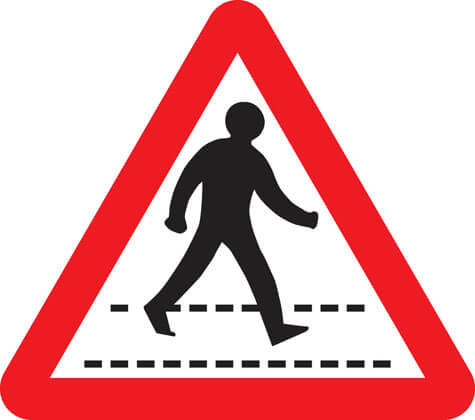
At a zebra crossing you must give way once someone has stepped onto it, and you should give way to anyone waiting at the kerb. A parallel crossing is the version with a cycle lane running alongside the zebra stripes, and cyclists using it get the same treatment as pedestrians.
The Highway Code, Rule 195: Zebra and parallel crossings. As you approach a zebra crossing
- look out for pedestrians waiting to cross and be ready to slow down or stop to let them cross
- you should give way to pedestrians waiting to cross
- you MUST give way when a pedestrian has moved onto a crossing
- allow more time for stopping on wet or icy roads
- do not wave, flash your lights or use your horn to invite pedestrians across; this could be dangerous if another vehicle is approaching
- be patient, do not sound your horn or rev your engine as this can be intimidating
- be aware of pedestrians approaching from the side of the crossing.
A zebra crossing with a central island is two separate crossings (see Rules 19 and 20). Parallel crossings are similar to zebra crossings, but include a cycle route alongside the black and white stripes. As you approach a parallel crossing
- look out for pedestrians or cyclists waiting to cross and slow down or stop
- you should give way to pedestrians or cyclists waiting to cross
- you MUST give way when a pedestrian or cyclist has moved onto a crossing
- allow more time for stopping on wet or icy roads
- do not wave, flash your lights or use your horn to invite pedestrians or cyclists across; this could be dangerous if another vehicle is approaching
- be patient, do not sound your horn or rev your engine as this can be intimidating
- be aware of pedestrians or cyclists approaching from the side of the crossing.
A parallel crossing with a central island is two separate crossings (see Rules 19 and 20). Law TSRGD schedule 14 part 5
Two details are easy marks and easy to lose. A zebra crossing with an island in the middle counts as two separate crossings, so a pedestrian waiting on the island is waiting at a fresh crossing, not partway through yours. And you should never wave, flash your headlights or sound your horn to invite someone across — another vehicle may be approaching that neither of you can see.
The Highway Code, Rule 19: Zebra crossings. Give traffic plenty of time to see you and to stop before you start to cross. Vehicles will need more time when the road is slippery. Wait until traffic has stopped from both directions or the road is clear before crossing. Remember that traffic does not have to stop until someone has moved onto the crossing. Drivers and riders should give way to pedestrians waiting to cross and MUST give way to pedestrians on a zebra crossing (see Rule H2). Keep looking both ways, and listening, in case a driver or rider has not seen you and attempts to overtake a vehicle that has stopped. A zebra crossing with a central island is two separate crossings (see Rule 20). Law TSRGD Schedule 14 part 5
What is Rule H3 and why do cyclists keep coming up?
Rule H3 says do not cut across cyclists, horse riders or horse-drawn vehicles going straight ahead when you are turning or changing lane — the same courtesy you would automatically extend to another car.
The Highway Code, Rule H3: You should not cut across cyclists, horse riders or horse drawn vehicles going ahead when you are turning into or out of a junction or changing direction or lane, just as you would not turn across the path of another motor vehicle. This applies whether they are using a cycle lane, a cycle track, or riding ahead on the road and you should give way to them. Do not turn at a junction if to do so would cause the cyclist, horse rider or horse drawn vehicle going straight ahead to stop or swerve. You should stop and wait for a safe gap in the flow of cyclists if necessary. This includes when cyclists are:
- approaching, passing or moving off from a junction
- moving past or waiting alongside stationary or slow-moving traffic
- travelling around a roundabout
The rule applies whether they are in a cycle lane, on a cycle track, or simply riding on the road, and it holds whether you are turning left across them or right across their path. If turning would force them to brake or swerve, you wait.
The mirror image of this is the rule that protects you when you are the one going straight ahead:
The Highway Code, Rule 76: Going straight ahead. If you are going straight ahead at a junction, you have priority over traffic waiting to turn into or out of the side road, unless road signs or markings indicate otherwise (see Rule H3). Check that you can proceed safely, particularly when approaching junctions on the left alongside stationary or slow-moving traffic. Watch out for drivers intending to turn across your path. Remember the driver ahead may not be able to see you, so bear in mind your speed and position in the road. Take great care when deciding whether it is safe to pass stationary or slow-moving lorries and other long vehicles, especially at the approach to junctions, as their drivers may not be able to see you. Remember that they may have to move over to the right before turning left, and that their rear wheels may then come very close to the kerb while turning (see Rule 67).
Read together, these two make the point that the hierarchy is not about vehicle type at all. It is about who is passing whom, and who would come off worse.
Where does the hierarchy show up in the theory test?
Across the four official question banks in the Drivingo app, 33 questions turn on priority, giving way and zebra crossings — 11 in the car bank, 8 in motorcycle, 11 in LGV/PCV and 3 in ADI. The concept is disproportionately represented in the LGV and PCV banks, which follows directly from H1: the bigger the vehicle, the more the Code expects of the person driving it.
They rarely announce themselves as hierarchy questions. They arrive as ordinary junction scenarios, and the correct answer is the one that assumes the more vulnerable road user has not seen you. Our guide to the hardest theory test topics covers the other areas that catch people out for similar reasons, and roundabout rules deals with the junction type where priority questions are most concentrated.
How should I revise this?
Learn the three rules by what they ask of you rather than by number. H1 is the principle — greater harm, greater responsibility. H2 is pedestrians at junctions and crossings. H3 is not cutting across cyclists and horse riders. Almost every question on the topic is one of those three wearing a different set of clothes.
Then check yourself on the "should versus MUST" split, because that is where confident candidates lose marks. Knowing that you must stop for someone already on a zebra crossing is not the same as knowing you should stop for someone waiting to use one.
Drivingo drills all four official banks with explanations that link each answer back to the rule it comes from, and the full Highway Code — including H1, H2 and H3 with their official illustrations — reads offline inside the app. Download Drivingo and turn priority into a topic you get right without thinking.
Contains public sector information licensed under the Open Government Licence v3.0.