DRIVINGO
Theory test
Zebra, Pelican, Puffin and Toucan Crossings: What's the Difference?
Published
The difference comes down to two things: whether the crossing has traffic lights, and who is allowed to use it. A zebra crossing has no lights at all. Pelican, puffin and toucan crossings are all controlled by signals, and they differ in how those signals behave and in whether cyclists may ride across.
The theory test treats each type as its own topic, so knowing "it's a crossing, slow down" isn't enough. Here is what sets each one apart.
What are the differences at a glance?
| Crossing | Traffic lights? | What drivers see after red | Who uses it |
|---|---|---|---|
| Zebra | No: black-and-white stripes and flashing amber beacons | Nothing: you give way instead | Pedestrians |
| Parallel | No: a zebra with a cycle route alongside | Nothing: you give way instead | Pedestrians and cyclists |
| Pelican | Yes | Flashing amber | Pedestrians |
| Puffin | Yes | Red and amber together, as at ordinary traffic lights | Pedestrians |
| Toucan | Yes | Red and amber together, as at ordinary traffic lights | Pedestrians and cyclists, who may ride across |
| Equestrian | Yes | Red and amber together, as at ordinary traffic lights | Horse riders |
If you remember one line from this table, make it the pelican row. It is the only signal-controlled crossing with a flashing amber phase, and that phase has its own rule.
What must you do at a zebra crossing?
You must give way to anyone who has stepped onto the crossing, and you should give way to anyone waiting to cross. There are no lights to tell you when, so the judgement is yours: watch the kerb on the approach and ease off early enough to stop if someone is about to cross.
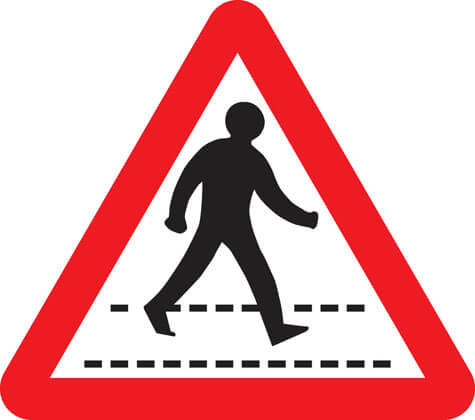
The Highway Code, Rule 195: Zebra and parallel crossings. As you approach a zebra crossing
- look out for pedestrians waiting to cross and be ready to slow down or stop to let them cross
- you should give way to pedestrians waiting to cross
- you MUST give way when a pedestrian has moved onto a crossing
- allow more time for stopping on wet or icy roads
- do not wave, flash your lights or use your horn to invite pedestrians across; this could be dangerous if another vehicle is approaching
- be patient, do not sound your horn or rev your engine as this can be intimidating
- be aware of pedestrians approaching from the side of the crossing.
A zebra crossing with a central island is two separate crossings (see Rules 19 and 20). Parallel crossings are similar to zebra crossings, but include a cycle route alongside the black and white stripes. As you approach a parallel crossing
- look out for pedestrians or cyclists waiting to cross and slow down or stop
- you should give way to pedestrians or cyclists waiting to cross
- you MUST give way when a pedestrian or cyclist has moved onto a crossing
- allow more time for stopping on wet or icy roads
- do not wave, flash your lights or use your horn to invite pedestrians or cyclists across; this could be dangerous if another vehicle is approaching
- be patient, do not sound your horn or rev your engine as this can be intimidating
- be aware of pedestrians or cyclists approaching from the side of the crossing.
A parallel crossing with a central island is two separate crossings (see Rules 19 and 20). Law TSRGD schedule 14 part 5
Two details in that rule catch people out.
Don't wave pedestrians across. It feels polite, but you can only vouch for your own vehicle. A driver or rider coming the other way, or overtaking you, may not have stopped.
A zebra crossing with a central island is two separate crossings. Someone waiting on the island is waiting at a new crossing, and traffic on the far side treats it that way too.
The priority rule itself comes from the Hierarchy of Road Users, which puts the greatest responsibility on those who can do the most harm. Our guide to Rules H1, H2 and H3 covers where else pedestrians now have priority.
Flashing amber at a pelican crossing: stop or go?
Flashing amber means give way to anyone still on the crossing; if it is clear, you may go. It is not a second red light, and it is not a green one.
The Highway Code, Rule 196: Pelican crossings. These are signal-controlled crossings where flashing amber follows the red ‘Stop’ light. You MUST stop when the red light shows. When the amber light is flashing, you MUST give way to any pedestrians on the crossing. If the amber light is flashing and there are no pedestrians on the crossing, you may proceed with caution. Laws TSRGD reg 14 & RTRA sect 25(5)
A pelican crossing is operated by the pedestrian pressing a button. For drivers the sequence runs red, then flashing amber, then green. While the amber flashes, pedestrians see a flashing green figure, which tells them not to start crossing but gives those already in the road time to finish.
So during flashing amber you wait for the person halfway across, and you move off once the crossing is empty. Revving the engine or creeping forward to hurry someone along is exactly what the Highway Code tells you not to do.
Pelican crossings also reverse the zebra's island rule. One that runs straight across the road is a single crossing, even with an island in the middle, so you must wait for people crossing from the far side. Only a staggered pelican, where the two halves don't line up, counts as two crossings.
The Highway Code, Rule 197: Pelican crossings which go straight across the road are one crossing, even when there is a central island. You MUST wait for pedestrians who are crossing from the other side of the island. Law TSRGD reg 14
How is a puffin crossing different from a pelican?
A puffin crossing has no flashing amber phase. Its lights run in the same order as ordinary traffic lights, so the signal that follows green is a steady amber.
Two things make that possible. Sensors watch the crossing and hold the traffic on red until it is clear, so the lights no longer need an in-between phase for stragglers. And the red and green figures sit on the pedestrian's own side of the road, above the button, where they can watch the signal and the approaching traffic together.
For a driver, that makes a puffin crossing simple: treat it exactly as you would a set of traffic lights.
The Highway Code, Rule 199: Toucan, puffin and equestrian crossings. These are similar to pelican crossings, but there is no flashing amber phase; the light sequence for traffic at these three crossings is the same as at traffic lights. If the signal-controlled crossing is not working, proceed with extreme caution. Do not enter the crossing if you are unable to completely clear it, to avoid obstructing pedestrians, cyclists or horse riders.
Who can use a toucan crossing?
Pedestrians and cyclists share a toucan crossing, and cyclists are allowed to ride across. The name is the memory aid: "two can" cross together.
The signals behave like a puffin's, with no flashing amber. What changes is who you should expect in front of you. A cyclist joins the crossing faster than someone on foot, so check both sides of the road as the lights change.
Riding across is a toucan privilege only. At zebra, pelican and puffin crossings the Highway Code tells cyclists to get off and wheel their cycle over. The exception is a parallel crossing, where the marked cycle route beside the stripes is there to be ridden, and you must give way to cyclists on it just as you would to pedestrians.
Equestrian crossings follow the same signal pattern for horse riders. You can recognise one by the wider crossing space, the barriers at the pavement edge and a second, higher set of controls that a rider can reach from the saddle.
What do the zig-zag lines mean?
The white zig-zag lines on either side of a crossing mark an area where you must not park and must not overtake.
The Highway Code, Rule 191: You MUST NOT park on a crossing or in the area covered by the zig-zag lines. You MUST NOT overtake the moving vehicle nearest the crossing or the vehicle nearest the crossing which has stopped to give way to pedestrians. Laws RTRA sect 25(5) & TSRGD schedule 14 parts 1 and 5
Parking there hides people at the kerb from approaching traffic, and hides the traffic from them. The overtaking ban has a precise shape: you must not pass the moving vehicle nearest the crossing, or the vehicle nearest the crossing that has stopped to let someone cross. If the driver ahead has stopped at a crossing, assume there is a pedestrian you can't see yet.
Pedestrians have a matching rule: cross on the crossing itself, between the studs or over the stripes, not on the zig-zags beside it.
What if someone is still crossing when your light turns green?
You wait. A green light lets you go only when the way is clear, and the Highway Code spells that out for crossings.
The Highway Code, Rule 198: Give way to anyone still crossing after the signal for vehicles has changed to green. This advice applies to all crossings.
This matters most for older people, disabled people and anyone with young children, who may need longer than the signal allows. The same patience applies in a queue: don't drive onto any crossing unless you can clear it completely, or the next group of pedestrians will have to pick their way between stationary vehicles.
Pedestrian crossings in the theory test
Across the four official question banks in the Drivingo app, 49 questions turn on these crossings: 16 in the car bank, 12 in motorcycle, 16 in LGV/PCV and 5 in ADI. They come back to the same handful of facts:
- what flashing amber means at a pelican crossing
- which light follows green at a puffin crossing
- who may use a toucan crossing, and how it differs from a puffin
- giving way to people waiting at a zebra, and not waving them across
- whether a crossing with a central island is one crossing or two
- the zig-zag lines
Many of these questions sit under vulnerable road users, one of the hardest theory test topics, and the four names are easy to blur together. Learn each crossing by what makes it different and the questions become straightforward. When you're judging how early to slow down for one, our guide to stopping distances has the figures.
Drivingo drills every crossing question in the official practice banks, with explanations that tie each answer back to its Highway Code rule, and the full Code reads offline inside the app. Download Drivingo and make crossings a topic you get right without thinking.
Contains public sector information licensed under the Open Government Licence v3.0.