 DRIVINGO


Road signs
Bus Lanes and Cycle Lanes: Rules, Times and Signs
Published
You may not drive a car in a bus lane while it is operating, unless the blue sign beside it shows your type of vehicle. Outside its hours a bus lane is an ordinary lane, and anyone may use it. Cycle lanes work on the line painted beside them: a solid white line means you must keep out while the lane is in force, and a broken white line means you should keep out unless you have no other choice.
Most of what learners get wrong here comes down to reading the sign. The blue rectangle or circle at the start of the lane tells you three things: who may use it, when the restriction applies, and whether the lane runs with the traffic or against it. Here is each rule, with the Highway Code behind it.
Quick answers
| Question | Answer |
|---|---|
| Can I use a bus lane in a car? | Not during its hours of operation, unless the sign includes your vehicle |
| What if the sign shows no times? | The lane is in force at all times, every day |
| Who else may use a bus lane? | Only the vehicles drawn on the sign: often cycles and taxis, sometimes motorcycles |
| Can I stop in a bus lane? | Yes, to stop or to load and unload, unless signs say you may not |
| Can I turn left through a bus lane? | Where the lane breaks at a junction, you may use that stretch to turn left |
| Can I drive in a cycle lane? | Solid line: no, during its hours. Broken line: only if it cannot be avoided |
| Can I park in a cycle lane? | Never in a cycle lane while waiting restrictions apply, and never on a cycle track |
Are cars allowed in bus lanes?
Only when the lane is not in force, or at any time if the sign lists your vehicle. The Highway Code puts it in a single short rule.
The Highway Code, Rule 141: Bus lanes. These are shown by road markings and signs that indicate which (if any) other vehicles are permitted to use the bus lane. Unless otherwise indicated, you should not drive in a bus lane during its period of operation. You may enter a bus lane to stop, to load or unload where this is not prohibited.
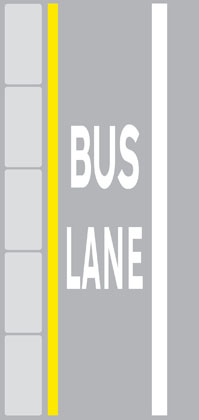
The start of a bus lane is marked on the road with a wide white line and the words BUS LANE, and there is an upright blue sign beside it. That sign is the part to read. It shows a bus, any other vehicles allowed to share the lane, and the days and hours it applies.
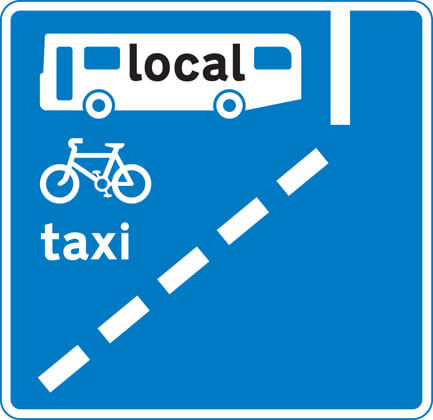
This sign warns of a with-flow bus lane ahead that cycles and taxis may also use. Our page on the with-flow bus lane ahead sign covers its variations.
Rule 141 is worded as advice ("should not"), but Rule 142, which covers lanes kept for particular types of vehicle, is firmer: during the hours on the sign you must keep out unless your vehicle is one the sign allows. Overtaking is covered too. Moving into a bus, tram or cycle lane during its hours to get past a queue is banned outright.
The Highway Code, Rule 165: You MUST NOT overtake
- if you would have to cross or straddle double white lines with a solid line nearest to you (but see Rule 129)
- if you would have to enter an area designed to divide traffic, if it is surrounded by a solid white line
- the nearest vehicle to a pedestrian crossing, especially when it has stopped to let pedestrians cross
- if you would have to enter a lane reserved for buses, trams or cycles during its hours of operation
- after a ‘No Overtaking’ sign and until you pass a sign cancelling the restriction.
Laws RTA 1988 sect 36 & TSRGD schedule 1, schedule 9 part 7, schedule 14 part 1
What are a bus lane's operating times, and what happens outside them?
The times on the sign are when the lane is reserved. Outside them, any vehicle may drive in it. A plate such as "Mon to Fri 7–10 am, 4–7 pm" means the lane is bus-only at those times and a normal lane the rest of the week.
Two details catch people out:
- No times on the sign means the lane never switches off. It is reserved 24 hours a day, seven days a week.
- Bank holidays do not suspend it. A Monday-to-Friday lane is still reserved on a bank holiday Monday.
When the lane ends, the road markings show that traffic may use both lanes again.
Who is allowed to use a bus lane?
Buses, plus whatever else is drawn on the sign, and nothing more. There is no blanket list. Each lane has its own sign, and the vehicles allowed can include:
- pedal cycles, shown by a cycle symbol
- taxis, shown by the word "taxi"
- solo motorcycles, shown by a motorcycle symbol
- authorised vehicles, where the sign says so
If a symbol is missing, that vehicle may not use the lane. A motorcyclist, for example, may only ride in a bus lane whose sign includes the motorcycle.
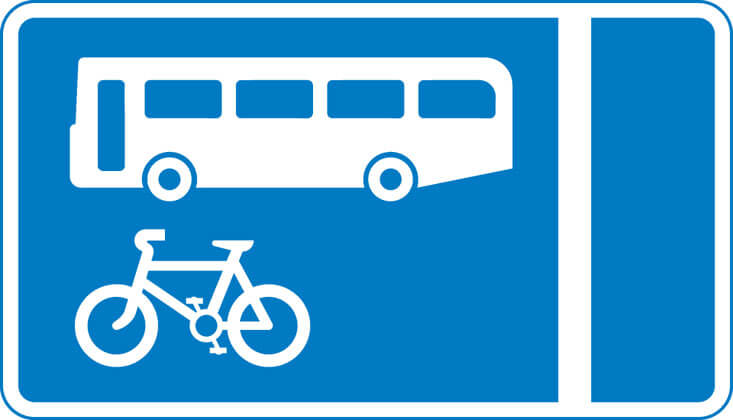
This is the sign for a with-flow bus and pedal cycle lane: buses and cycles only, during the times shown.
The bus itself matters too. If the bus symbol carries the word "local", only buses running a local service may use the lane. Without that word, the lane is open to local buses and to any vehicle built to carry 10 or more people including the driver, so a minibus or coach qualifies.
Can you stop or park in a bus lane?
You may stop in a bus lane to set down or load, unless a sign by the lane forbids it. Rule 240, the list of places where you must not stop or park, says so in its last line.
The Highway Code, Rule 240: You MUST NOT stop or park on
- the carriageway, an emergency area or a hard shoulder of a motorway except in an emergency (see Rules 270 and 271)
- a pedestrian crossing, including the area marked by the zig-zag lines (see Rule 191)
- a clearway (see Traffic signs)
- taxi bays as indicated by upright signs and markings
- an urban clearway within its hours of operation, except to pick up or set down passengers (see Traffic signs)
- a road marked with double white lines, even when a broken white line is on your side of the road, except to pick up or set down passengers, or to load or unload goods
- a tram or cycle lane during its period of operation
- a cycle track
- red lines, in the case of specially designated ‘red routes’, unless otherwise indicated by signs. Any vehicle may enter a bus lane to stop, load or unload where this is not prohibited (see Rule 141).
Laws MT(E&W)R regs 7 & 9 as amended by MT(E&W)(A)(E)R, MT(S)R regs 6 & 8, RTRA sects 5, 6 and 8, TSRGD schedule 7 parts 2, 3, 4, 5 and 7, schedule 9 part 6, schedule 14 parts 1 and 5
Note the difference in that list. A bus lane allows a brief stop to load or unload, but a cycle lane in operation and a cycle track do not allow stopping at all.
Can you turn left across a bus lane?
Yes, where the bus lane is broken at a junction. Use the break to move left and make your turn. In the gap a bus lane leaves before a junction, any vehicle may move into that nearside lane, provided it is turning left. You may not use that gap to drive ahead.
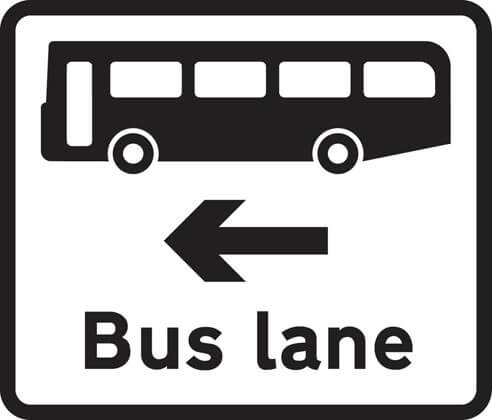
The bigger risk is not the paint but who is in the lane. Buses, cycles and taxis may be moving faster than your queue, and a cyclist may be coming up on your left. Before you turn, check your left mirror and blind spot, and give way to anything in the lane.
The Highway Code, Rule 183: When turning
- keep as close to the left as is safe and practicable
- give way to any vehicles using a bus lane, cycle lane, cycle track or tramway from either direction, including when they are passing slow moving or stationary vehicles on either side.
Are bus lanes enforced by cameras?
Many are. Bus lanes and bus gates are often watched by fixed cameras, and a vehicle that drives along one during its hours can be sent a penalty charge notice, which goes to the registered keeper. The amount is set locally, so it varies across the country. The safest habit is to read the times on every sign as you pass, rather than assuming a lane is off because it looks empty.
What is the difference between a with-flow and a contraflow lane?
A with-flow lane runs in the same direction as the traffic beside it. A contraflow lane runs the opposite way, usually against a one-way street. That is the whole distinction, and the sign shows it.
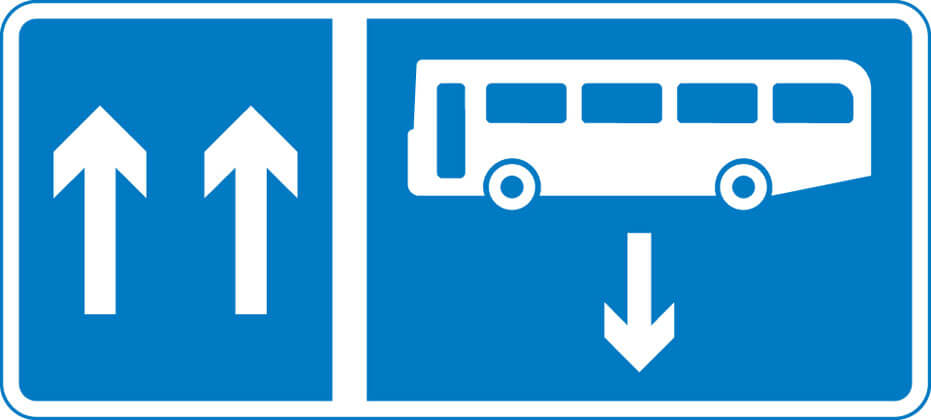
On a contraflow bus lane sign, the upward arrows show the number of lanes for ordinary traffic, and the bus lane points the other way. Contraflow lanes let buses and cycles take a short, direct route through a one-way system that cars must go round.
The Highway Code, Rule 143: One-way streets. Traffic MUST travel in the direction indicated by signs. Buses and/or cycles may have a contraflow lane. Choose the correct lane for your exit as soon as you can. Do not change lanes suddenly. Unless road signs or markings indicate otherwise, you should use
- the left-hand lane when going left
- the right-hand lane when going right
- the most appropriate lane when going straight ahead. Remember – traffic could be passing on both sides.
Laws RTA 1988 sect 36 & RTRA sects 5 & 8
The danger with a contraflow lane is that traffic arrives from an unexpected direction. Pedestrians are warned about it as well, because a person who checks only the way the cars go may step in front of a bus.
The Highway Code, Rule 11: One-way streets. Check which way the traffic is moving. Do not cross until it is safe to do so without stopping. Bus and cycle lanes may operate in the opposite direction to the rest of the traffic.
What does a bus gate mean for drivers?
A bus gate is a short stretch of road that only buses, and any other vehicles shown on its sign, may drive through. It lets buses take a direct route while stopping other traffic using that street as a short cut.
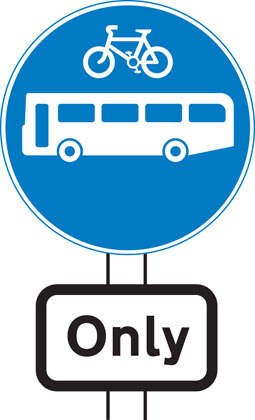
A bus gate is marked with a round blue sign showing the vehicles allowed, here buses and cycles only. A time plate underneath means it applies only at those times; with no plate, it applies all the time. Bus gates are commonly camera-enforced, so a satnav that routes you through one does not make it legal.
What do solid and broken cycle lane lines mean?
A solid white line marks a mandatory cycle lane: you must not drive or park in it during its hours. A broken white line marks an advisory lane: you should not drive or park in it unless it is unavoidable.
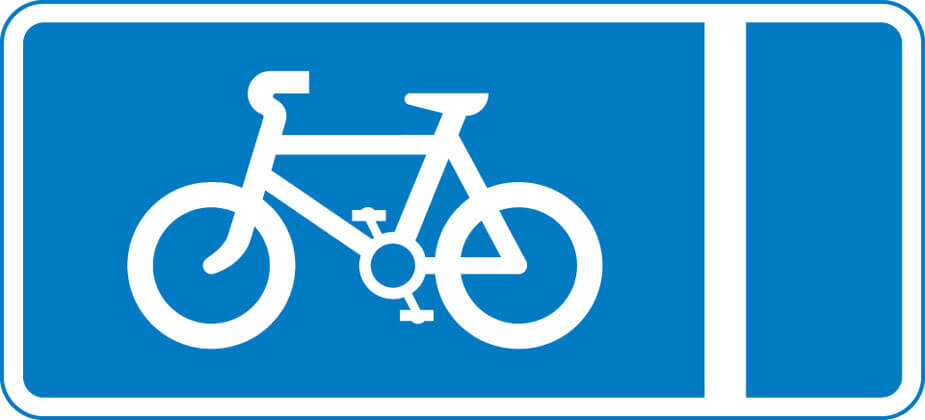
The sign above goes with a mandatory lane. Our page on the with-flow pedal cycle lane sign shows how it looks on the road. An advisory lane may have no upright sign at all, just the broken line and a cycle symbol on the road.
The Highway Code, Rule 140: Cycle lanes and cycle tracks. Cycle lanes are shown by road markings and signs. You MUST NOT drive or park in a cycle lane marked by a solid white line during its times of operation. Do not drive or park in a cycle lane marked by a broken white line unless it is unavoidable. You MUST NOT park in any cycle lane whilst waiting restrictions apply. You should give way to any cyclists in a cycle lane, including when they are approaching from behind you – do not cut across them when you are turning or when you are changing lane (see Rule H3). Be prepared to stop and wait for a safe gap in the flow of cyclists before crossing the cycle lane. Cycle tracks are routes for cyclists that are physically protected or located away from motor traffic, other than where they cross side roads. Cycle tracks may be shared with pedestrians. You should give way to cyclists approaching or using the cycle track when you are turning into or out of a junction (see Rule H3). Be prepared to stop and wait for a safe gap in the flow of cyclists before crossing the cycle track, which may be used by cyclists travelling in both directions. Bear in mind that cyclists are not obliged to use cycle lanes or cycle tracks. Law RTRA sects 5 & 8
"Unavoidable" in an advisory lane means things like passing a stopped vehicle on a narrow road, not using the lane as a parking space. And the rule ends with a point worth remembering for questions about cyclists on the main road: cyclists do not have to use a cycle lane or track. A cyclist riding next to an empty cycle lane is doing nothing wrong.
What is a cycle track?
A cycle track is a route for cycles kept apart from motor traffic, by a kerb, a verge or a physical barrier, or set away from the road altogether. A cycle lane is part of the carriageway; a cycle track is not. Some tracks are shared with pedestrians, and some are split into a cycle side and a walking side.
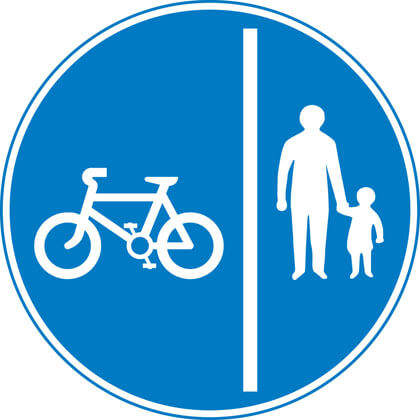
You must not stop or park on a cycle track at any time. Tracks also run across side roads and driveways, and cyclists on them may come from either direction. When you are turning in or out of a junction across a track, or crossing one to reach a driveway, give way to the cyclists on it.
The Highway Code, Rule 206: Drive carefully and slowly when
- in crowded shopping streets, Home Zones and Quiet Lanes (see Rule 218) or residential areas
- driving past bus and tram stops; pedestrians may emerge suddenly into the road
- passing parked vehicles, especially ice cream vans; children are more interested in ice cream than traffic and may run into the road unexpectedly
- needing to cross a pavement, cycle lane or cycle track; for example, to reach or leave a driveway or private access. Give way to pedestrians on the pavement and cyclists using a cycle lane or cycle track
- reversing into a side road; look all around the vehicle and give way to any pedestrians who may be crossing the road
- turning at road junctions; you should give way to pedestrians who are crossing or waiting to cross the road into which or from which you are turning
- going through road works or when passing roadside rescue and recovery vehicles, as there may be people working in or at the side of the road
- the pavement is closed due to street repairs and pedestrians are directed to use the road
- approaching pedestrians on narrow rural roads without a footway or footpath. Always slow down and be prepared to stop if necessary, giving them plenty of room as you drive past
- approaching zebra and parallel crossings as you MUST give way to pedestrians and cyclists on the crossing (see Rule 195)
- approaching pedestrians who have started to cross the road ahead of you. They have priority when crossing at a junction or side road so you should give way (see Rule H2).
Law TSRGD schedule 14 Part 5
The Highway Code's hierarchy rules make the same point more strongly: do not turn across a cyclist going straight ahead, whether they are in a lane, on a track or on the road. Our guide to the hierarchy of road users explains where Rule H3 fits.
The Highway Code, Rule H3: You should not cut across cyclists, horse riders or horse drawn vehicles going ahead when you are turning into or out of a junction or changing direction or lane, just as you would not turn across the path of another motor vehicle. This applies whether they are using a cycle lane, a cycle track, or riding ahead on the road and you should give way to them. Do not turn at a junction if to do so would cause the cyclist, horse rider or horse drawn vehicle going straight ahead to stop or swerve. You should stop and wait for a safe gap in the flow of cyclists if necessary. This includes when cyclists are:
- approaching, passing or moving off from a junction
- moving past or waiting alongside stationary or slow-moving traffic
- travelling around a roundabout
What is an advanced stop line?
An advanced stop line is a second stop line at traffic lights that gives cyclists a waiting box in front of the other traffic. The marked area between the two lines, with a cycle symbol painted in it, is for cyclists only when the lights are red.
The Highway Code, Rule 178: Advanced stop lines. Some signal-controlled junctions have advanced stop lines to allow cyclists to be positioned ahead of other traffic. Motorists, including motorcyclists, MUST stop at the first white line reached if the lights are amber or red and should avoid blocking the way or encroaching on the marked area at other times, e.g. if the junction ahead is blocked. If your vehicle has proceeded over the first white line at the time that the signal goes red, you should stop as soon as possible and MUST stop at the second white line. Allow cyclists, including any moving or waiting alongside you, enough time and space to move off when the green signal shows. Drivers of large vehicles should stop sufficiently far behind the first white line so that they can see the whole area where cyclists may be waiting, allowing for any blind spot in front of the vehicle. Laws RTA 1988 sect 36 & TSRGD Schedule 14 part 1
So when the lights are amber or red, you stop at the first line, the one nearest you. If the lights changed as you were crossing it, you stop as soon as you can and must not go past the second line. On green, give the cyclists ahead time to move off before you pull away. Cyclists may cross the first line at any point to reach the box, and there is not always a cycle lane leading up to it.
Bus lanes and cycle lanes in the theory test
Bus and cycle lanes come up across every question bank in the Drivingo app, usually as a picture of a sign or a road marking. The patterns repeat:
- what a bus lane sign means when it shows no hours
- which road users are allowed in a bus lane, and why a motorcyclist depends on the sign
- when a car driver may use a bus lane or a cycle lane
- the difference between a solid and a broken cycle lane line
- where you would expect a contraflow lane
- what the advanced stop line box is for, and where to wait at a red light
- what a bus gate is, in the instructor bank
They are closely linked to the yellow and red lines, because both are about reading paint and plates together, and to road sign shapes: a blue circle gives an order, a blue rectangle gives information.
Drivingo drills every sign and road marking question in its practice banks, with explanations that link each answer to its Highway Code rule, and the full Code reads offline inside the app. Download Drivingo and get bus lanes and cycle lanes right first time.
Contains public sector information licensed under the Open Government Licence v3.0.