DRIVINGO
Theory test
UK Speed Limits by Road Type: 20, 30, 60 and 70 mph Explained
Published
For a car in England and Scotland the national speed limits are 30 mph on a road with street lights, 60 mph on a single carriageway and 70 mph on a dual carriageway or motorway. In Wales the street-lit figure is 20 mph. Every other limit you meet is either a sign telling you something different or a lower figure that applies to the vehicle you are driving.
That is the whole topic in two sentences, but the theory test asks it from several angles: what the limit is when there is no sign, what the striped white circle means, how towing changes the figures, and which other rules switch on and off at 30 mph. Here is each one in turn.
What are the national speed limits for a car?
| Road | England and Scotland | Wales |
|---|---|---|
| Built-up area (a road with street lights) | 30 mph | 20 mph |
| Single carriageway | 60 mph | 60 mph |
| Dual carriageway | 70 mph | 70 mph |
| Motorway | 70 mph | 70 mph |
These are maximums, set by law, and the Highway Code gives the full table for every class of vehicle in one rule. It is the rule to learn for this topic.
The Highway Code, Rule 124: You MUST NOT exceed the maximum speed limits for the road and for your vehicle (see the table below). A speed limit of 30 mph (48 km/h), or 20mph (32km/h) in Wales, generally applies to all roads with street lights (excluding motorways) unless signs show otherwise. Speed Limits Built-up areas, England, Scotland Built up areas, Wales Single carriageways Dual carriageways Motorways Type of vehicle mph (km/h) mph (km/h) mph (km/h) mph (km/h) mph (km/h) Cars & motorcycles (including car derived vans up to 2 tonnes maximum laden weight) 30 (48) 20 (32) 60 (96) 70 (112) 70 (112) Cars towing caravans or trailers (including car derived vans and motorcycles) 30 (48) 20 (32) 50 (80) 60 (96) 60 (96) Motorhomes or motor caravans (not exceeding 3.05 tonnes maximum unladen weight) 30 (48) 20 (32) 60 (96) 70 (112) 70 (112) Motorhomes or motor caravans (exceeding 3.05 tonnes maximum unladen weight) 30 (48) 20 (32) 50 (80) 60 (96) 70 (112) Buses, coaches and minibuses (not exceeding 12 metres in overall length) 30 (48) 20 (32) 50 (80) 60 (96) 70† (112) Goods vehicles (not exceeding 7.5 tonnes maximum laden weight) 30 (48) 20 (32) 50 (80) 60 (96) 70†† (112) Goods vehicles (exceeding 7.5 tonnes maximum laden weight) in England and Wales 30 (48) 20 (32) 50 (80) 60 (96) 60 (96) Goods vehicles (exceeding 7.5 tonnes maximum laden weight) in Scotland 30 (48) 20 (32) 40 (64) 50 (80) 60 (96) † 60 mph (96 km/h) if exceeding 12 metres in overall length. †† 60 mph (96 km/h) if articulated or towing a trailer. For speed limits that apply to special types of vehicles, such as oversized vehicles, see Further reading. Locally set speed limits may apply, for example
- 20 mph (32 km/h) in some built-up areas in England and Scotland
- 30 mph (48 km/h) in some built-up areas in Wales
- 50 mph (80 km/h) on single carriageways with known hazards
- variable speed limit signs are used on some motorways and dual carriageways to change the maximum speed limit.
Speed limits are enforced by the police. Law RTRA sects 81, 86, 89 & sched 6 as amended by MV(VSL)(E&W), RR(20)O
Note the word generally in that rule. A lit road is 30 mph (20 in Wales) unless a sign says otherwise, and councils do set other limits locally: 20 mph on some streets in England and Scotland, 30 mph on some roads in Wales, 50 mph on single carriageways with a known hazard, and variable limits on some motorways and dual carriageways. The sign always wins over the default.
How do you know the speed limit if there are no signs?
Look for street lights. If the road has them, it is a built-up area and the limit is 30 mph in England, Scotland and Northern Ireland, or 20 mph in Wales, unless a sign shows a different figure. If the road has no street lights and no signs, the national speed limit applies: 60 mph on a single carriageway and 70 mph on a dual carriageway for a car.
Street lighting is the test the Highway Code uses in more than one place. The lighting rule makes the same link between lit roads and the 30 mph limit when it tells you where you may drive at night on sidelights alone.
The Highway Code, Rule 113: You MUST
- ensure all sidelights and rear registration plate lights are lit between sunset and sunrise
- use headlights at night, except on a road which has lit street lighting. These roads are generally restricted to a speed limit of 30 mph (48 km/h), or 20mph (32km/h) in Wales, unless otherwise specified
- use headlights when visibility is seriously reduced (see Rule 226).
Night (the hours of darkness) is defined as the period between half an hour after sunset and half an hour before sunrise. Laws RVLR regs 3, 24 & 25 (In Scotland - RTRA sect 82 (as amended by NRSWA, para 59 of sched 8)), RR(20)O
So when a question describes a road with lamp posts and no signs, the answer is the built-up figure. When it describes a road with no lamp posts and no signs, the answer is whichever national limit applies to that kind of carriageway.
What does the national speed limit sign mean?
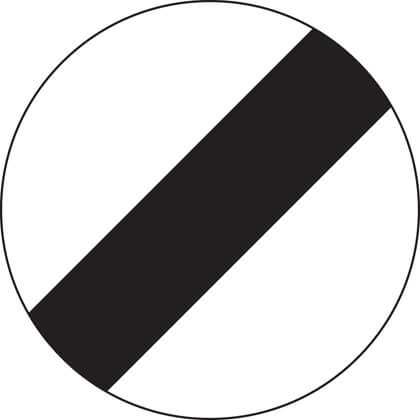
The white circle with a black diagonal band means the national speed limit applies from here. It does not mean 60 or 70 by itself. The figure depends on the road and on what you are driving: for a car it is 60 mph on a single carriageway and 70 mph on a dual carriageway, and for a car towing a trailer it drops to 50 and 60.
You will usually see it where a 30 or 40 mph limit ends and the road opens out. The sign that sets a specific limit is the plain red circle with a number inside it, and that number is the maximum until the next sign changes it.
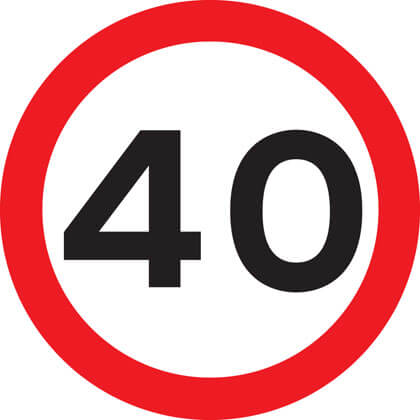
Both are circular signs giving orders, which is why they are red-ringed or carry a black band rather than a triangle. Our guide to road sign shapes explains how the shape tells you whether a sign orders, warns or informs.
What is a 20 mph zone?
A 20 mph zone is an area, usually residential, where 20 mph is the maximum throughout, marked once at the entrance and once at the exit rather than with repeater signs on every lamp post. Inside it you will often find traffic calming such as road humps and chicanes, which is a clue that the limit is still in force even if you have not seen a sign for a while.
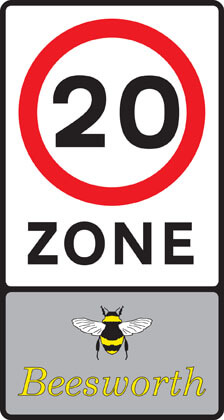
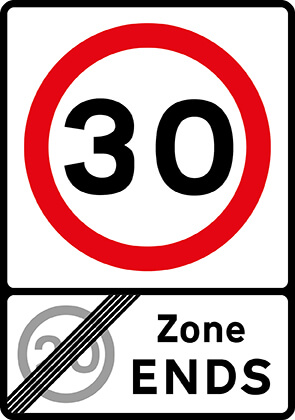
The Highway Code treats residential streets as a hazard in their own right, whatever the posted limit.
The Highway Code, Rule 152: Residential streets. You should drive slowly and carefully on streets where there are likely to be pedestrians, cyclists and parked cars. In some areas a 20 mph (32 km/h) maximum speed limit may be in force. Look out for
- vehicles emerging from junctions or driveways
- vehicles moving off
- car doors opening
- pedestrians
- children running out from between parked cars
- cyclists and motorcyclists.
In Wales the position is reversed: 20 mph is the default on street-lit roads, and a 30 mph limit there is the exception that needs a sign. Rule 124 now carries a separate column for it.
Why 20 and 30 rather than any other number?
Because of what happens to a pedestrian at each speed. The Highway Code is unusually blunt about this.
The Highway Code, Rule 207: Particularly vulnerable pedestrians. These include:
- children and older pedestrians who may not be able to judge your speed and could step into the road in front of you. At 40 mph (64 km/h) your vehicle will probably kill any pedestrians it hits. At 20 mph (32 km/h) there is only a 1 in 20 chance of the pedestrian being killed. So kill your speed
- older pedestrians who may need more time to cross the road. Be patient and allow them to cross in their own time. Do not hurry them by revving your engine or edging forward
- people with disabilities. People with hearing impairments may not be aware of your vehicle approaching. Those with walking difficulties require more time
- blind or partially sighted people, who may be carrying a white cane using a guide dog. They may not be able to see you approaching
- deafblind people who may be carrying a white cane with a red band or using a dog with a red and white harness. They may not see or hear instructions or signals.
That is the reasoning behind every built-up limit: 20 and 30 mph are the speeds at which a vehicle can usually stop in time for a child stepping out, and at which a collision is survivable if it cannot. Our guide to stopping distances shows how much further a car travels before it stops at each of these speeds.
Do speed limits change when you are towing or driving a larger vehicle?
Yes. Towing a caravan or trailer with a car cuts the limits to 50 mph on a single carriageway and 60 mph on a dual carriageway or motorway. The built-up limit stays at 30 (20 in Wales) because nothing is allowed to go faster than that in town anyway.
Larger vehicles have their own rows in the Rule 124 table:
| Vehicle | Single carriageway | Dual carriageway | Motorway |
|---|---|---|---|
| Car or motorcycle | 60 mph | 70 mph | 70 mph |
| Car towing a caravan or trailer | 50 mph | 60 mph | 60 mph |
| Bus, coach or minibus up to 12 m | 50 mph | 60 mph | 70 mph (60 if longer than 12 m) |
| Goods vehicle up to 7.5 tonnes | 50 mph | 60 mph | 70 mph (60 if articulated or towing) |
| Goods vehicle over 7.5 tonnes, England and Wales | 50 mph | 60 mph | 60 mph |
| Goods vehicle over 7.5 tonnes, Scotland | 40 mph | 50 mph | 60 mph |
This is why the lorry ahead of you on a motorway is not going to speed up. Many large vehicles are fitted with a limiter as well, and the Highway Code tells car drivers to allow for it.
The Highway Code, Rule 222: Large vehicles can block your view. Your ability to see and to plan ahead will be improved if you pull back to increase your separation distance. Be patient, as larger vehicles are subject to lower speed limits than cars and motorcycles. Many large vehicles may be fitted with speed limiting devices which will restrict speed to 56 mph (90 km/h) even on a motorway.
If you ever drive a van, check which row it belongs in. Most vans follow the goods-vehicle limits, which are lower than a car's on every road outside town.
Which other rules switch on at 30 mph?
Several, and they are regular theory test questions because the figure of 30 mph is the trigger rather than the subject.
Parking at night. On a road with a limit above 30 mph you must leave parking lights on. On a 30 mph road or slower you may park a car without lights, as long as you are facing the direction of traffic, at least 10 metres from a junction, or in a recognised parking place.
The Highway Code, Rule 249: All vehicles MUST display parking lights when parked on a road or a lay-by on a road with a speed limit greater than 30 mph (48 km/h). Law RVLR reg 24
The Highway Code, Rule 250: Cars, goods vehicles not exceeding 2500 kg laden weight, invalid carriages, motorcycles and pedal cycles may be parked without lights on a road (or lay-by) with a speed limit of 30 mph (48 km/h) or less if they are:
- at least 10 metres (32 feet) away from any junction, close to the kerb and facing in the direction of the traffic flow
- in a recognised parking place or lay-by.
Other vehicles and trailers, and all vehicles with projecting loads, MUST NOT be left on a road at night without lights. Laws RVLR reg 24 & CUR reg 82(7)
Headlights. After dark on a lit street you should still use dipped headlights, so that others see you even where the lamps are bright enough for you to see.
The Highway Code, Rule 115: You should also
- use dipped headlights, or dim-dip if fitted, at night in built-up areas and in dull daytime weather, to ensure that you can be seen
- keep your headlights dipped when overtaking until you are level with the other vehicle and then change to main beam if necessary, unless this would dazzle oncoming road users
- slow down, and if necessary stop, if you are dazzled by oncoming headlights.
The horn. Between 11.30 pm and 7.00 am you must not sound it on a built-up road, unless another road user is putting you in danger.
The Highway Code, Rule 112: The horn. Use only while your vehicle is moving and you need to warn other road users of your presence. Never sound your horn aggressively. You MUST NOT use your horn
- while stationary on the road
- when driving in a built-up area between the hours of 11.30 pm and 7.00 am
except when another road user poses a danger. Law CUR reg 99
Passing cyclists. The clearance you owe a cyclist is tied to speed: at least 1.5 metres when passing at up to 30 mph, and more above that. Horses get 2 metres and a pass at under 10 mph.
The Highway Code, Rule 215: Horse riders and horse-drawn vehicles. Be particularly careful of horse riders and horse-drawn vehicles especially when approaching, overtaking, passing or moving away. Always pass wide and slowly. When you see a horse on a road, you should slow down to a maximum of 10 mph. Be patient, do not sound your horn or rev your engine. When safe to do so, pass wide and slow, allowing at least 2 metres of space. Feral or semi feral ponies found in areas such as the New Forest, Exmoor and Dartmoor require the same consideration as ridden horses when approaching or passing. Horse riders are often children, so take extra care and remember riders may ride in double file when escorting a young or inexperienced horse or rider. Look out for horse riders’ and horse drivers’ signals and heed a request to slow down or stop. Take great care and treat all horses as a potential hazard; they can be unpredictable, despite the efforts of their rider/driver. Remember there are three brains at work when you pass a horse; the rider’s, the driver’s and the horse’s. Do not forget horses are flight animals and can move incredibly quickly if startled.
Is the speed limit a target?
No. The limit is the most you may do on that road in ideal conditions, and the Highway Code expects you to drive below it whenever the road, the weather or the traffic calls for it. Two situations are worth naming because they come up in questions.
Leaving a motorway is the first. After a spell at 70 mph your sense of speed is skewed, and the Code tells you to trust the instrument rather than your judgement.
The Highway Code, Rule 274: On leaving the motorway or using a link road between motorways, your speed may be higher than you realise - 50 mph may feel like 30 mph. Check your speedometer and adjust your speed accordingly. Some slip-roads and link roads have sharp bends, so you will need to slow down.
Residential streets are the second. Rule 152, quoted above, asks you to drive slowly on any street with parked cars and pedestrians regardless of whether a 20 mph limit is posted.
Speed limits in the theory test
Across the four official question banks in the Drivingo app, 30 questions mention a specific speed in mph or a built-up area: 6 in the car bank, 6 in motorcycle, 9 in LGV/PCV and 9 in ADI. The patterns repeat:
- the limit on a street-lit road with no signs, in England and Scotland and in Wales
- what the national speed limit sign allows on a single and a dual carriageway
- the lower limits for towing and for larger vehicles
- whether to leave parking lights on, which turns on the 30 mph figure
- dipped headlights and the horn in built-up areas
- the room to leave when passing a cyclist on a 30 mph road
Several of these sit under rules of the road and safety margins, two of the hardest theory test topics. The motorway figures overlap with the signals covered in our guide to motorway signs and signals, where a red X or a variable limit replaces the national figure.
Drivingo drills every speed limit question in the official practice banks, with explanations that tie each answer back to its Highway Code rule, and the full Code with the Rule 124 table reads offline inside the app. Download Drivingo and make speed limits a topic you get right without thinking.
Contains public sector information licensed under the Open Government Licence v3.0.