
Theory test
Stopping Distances Explained: The Figures You Need to Know
Published
At 70 mph, a car needs a typical stopping distance of 96 metres on a dry road. That's 315 feet, or about 24 car lengths. Even at 30 mph, the urban limit, you need 23 metres to stop.
Stopping distances appear again and again in the theory test, so it pays to understand where the figures come from rather than memorising them blindly. Here's the full official table, what the two parts mean, and how weather changes the numbers.
What is a stopping distance?
Your overall stopping distance is the distance your car travels from the moment you realise you must brake to the moment the car stops. It's made of two parts: thinking distance (how far you travel while you react) and braking distance (how far you travel once the brakes are on).
The Highway Code puts it like this:
The Highway Code, Rule 126: Stopping distances. Drive at a speed that will allow you to stop well within the distance you can see to be clear. You should
- leave enough space between you and the vehicle in front so that you can pull up safely if it suddenly slows down or stops. The safe rule is never to get closer than the overall stopping distance (see Typical Stopping Distances diagram)
- allow at least a two-second gap between you and the vehicle in front on high-speed roads and in tunnels where visibility is reduced. The gap should be at least doubled on wet roads and up to ten times greater on icy roads
- remember, large vehicles and motorcycles need a greater distance to stop. If driving a large vehicle in a tunnel, you should allow a four-second gap between you and the vehicle in front If you have to stop in a tunnel, leave at least a 5-metre gap between you and the vehicle in front. Tailgating is where the gap between you and the vehicle in front is too small for you to be able to stop safely if the vehicle in front suddenly brakes. Tailgating is dangerous, intimidating and can cause collisions, especially when driving at speed. Keeping a safe distance from the vehicle in front gives you time to react and stop if necessary. Dangerous and careless driving offences, such as tailgating, are enforced by the police.
What are the typical stopping distances?
These are the official Highway Code figures, based on a dry road, good tyres and good brakes:
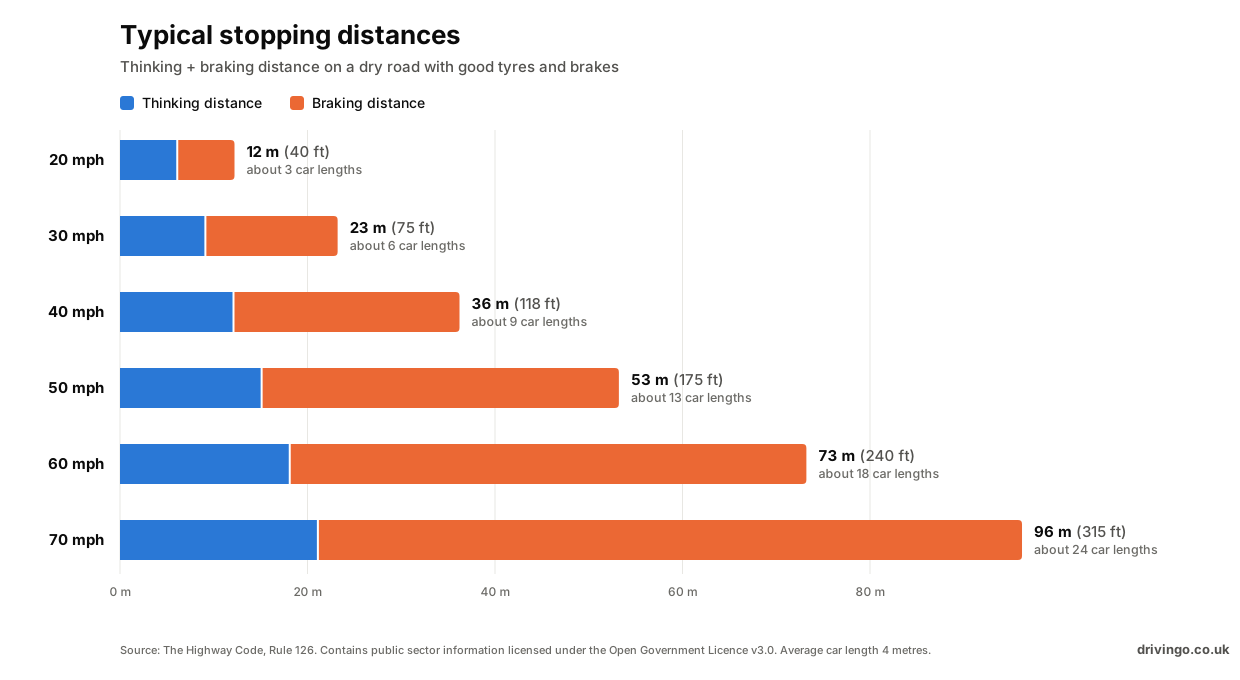
| Speed | Thinking distance | Braking distance | Total stopping distance |
|---|---|---|---|
| 20 mph | 6 m | 6 m | 12 m (40 ft) |
| 30 mph | 9 m | 14 m | 23 m (75 ft) |
| 40 mph | 12 m | 24 m | 36 m (118 ft) |
| 50 mph | 15 m | 38 m | 53 m (175 ft) |
| 60 mph | 18 m | 55 m | 73 m (240 ft) |
| 70 mph | 21 m | 75 m | 96 m (315 ft) |
A useful anchor for the exam: the average car is about 4 metres long, so 96 metres at 70 mph is roughly 24 car lengths of empty road.
What is thinking distance?
Thinking distance is how far you travel before you even touch the brake pedal. It grows in a straight line with speed: roughly 3 metres for every 10 mph. At 20 mph you cover 6 metres while reacting; at 70 mph you cover 21 metres.
That assumes an alert driver. Tiredness, alcohol, drugs and distractions such as a phone all stretch your reaction time, and every extra fraction of a second at speed is metres of road gone.
What is braking distance?
Braking distance is how far the car travels once the brakes are working, and it grows much faster than speed does. Double your speed from 30 mph to 60 mph and the braking distance roughly quadruples, from 14 metres to 55 metres.
That's the single most examinable idea in this topic: speed up a little, and the braking distance grows a lot. It also depends on the condition of your brakes and tyres, the road surface, and how heavily the vehicle is loaded.
How do rain and ice change stopping distances?
In the wet, stopping distances are at least double the dry figures, because your tyres have less grip. That 23 metres at 30 mph becomes 46 metres or more.
On ice, stopping distances can be ten times the dry figures. The same 30 mph stop can need over 230 metres. This is why driving to the conditions matters more than driving to the limit.
What is the two-second rule?
Rather than judging metres at speed, use time. Watch the vehicle ahead pass a fixed point, such as a sign, and say "only a fool breaks the two-second rule". If you pass the point before you finish, you're too close.
In the wet, double it to four seconds. On ice, leave up to ten times the normal gap. On high-speed roads and in tunnels, the Highway Code says a two-second gap is the minimum even in good conditions.
Do you need to memorise stopping distances for the theory test?
Yes, the figures are fair game, and so are the ideas behind them: which conditions increase your stopping distance, how much extra room to leave in rain or ice, and what affects thinking and braking distance. The current official question bank tests the concepts as much as the numbers.
Drivingo covers every stopping-distance question in the official practice bank, with explanations that show you the why behind each answer, and mock tests that tell you whether you'd pass today. Download Drivingo and see how ready you are.
Contains public sector information licensed under the Open Government Licence v3.0.