DRIVINGO
Theory test
When to Use Fog Lights, Dipped Headlights and Sidelights
Published
The rule of thumb is 100 metres. When you cannot see that far ahead, you must switch your headlights on, and you may add front or rear fog lights. The moment visibility improves, the fog lights must go off again. Dipped headlights go on at night in built-up areas and in dull daytime weather, whether or not you need them to see, because they are there to make sure you are seen.
The theory test turns this into a cluster of questions: when fog lights are allowed, when they must be switched off, why a motorcyclist rides on dipped beam in daylight, what a flash of headlights means, and what to do when another driver's lights dazzle you. Here is each one against the Highway Code rule behind it.
Which lights should you use, and when?
| Situation | What the Highway Code says |
|---|---|
| Between sunset and sunrise | Sidelights and rear number-plate lights must be lit |
| Night, on a road without street lights | Headlights must be on |
| Night, on a street-lit road | Sidelights are the legal minimum; use dipped headlights to be seen |
| Dull daytime weather | Dipped headlights, to be seen |
| Visibility under about 100 metres | Headlights must be on; front or rear fog lights may be added |
| Visibility improving again | Fog lights must be switched off |
| Parked on the road in fog | Leave parking lights or sidelights on |
| Stopping at the roadside | Switch off the engine, headlights and fog lights |
The rest of this article is those rows in detail, with the rules that set them.
When are headlights compulsory?
At night on any road without street lighting, and whenever visibility is seriously reduced. Between sunset and sunrise your sidelights and rear number-plate lights must be on as well. The Highway Code is precise about what night means here: it starts half an hour after sunset and ends half an hour before sunrise.
The Highway Code, Rule 113: You MUST
- ensure all sidelights and rear registration plate lights are lit between sunset and sunrise
- use headlights at night, except on a road which has lit street lighting. These roads are generally restricted to a speed limit of 30 mph (48 km/h), or 20mph (32km/h) in Wales, unless otherwise specified
- use headlights when visibility is seriously reduced (see Rule 226).
Night (the hours of darkness) is defined as the period between half an hour after sunset and half an hour before sunrise. Laws RVLR regs 3, 24 & 25 (In Scotland - RTRA sect 82 (as amended by NRSWA, para 59 of sched 8)), RR(20)O
Notice the exception. On a street-lit road the law does not insist on headlights, and the Code ties that exception to the roads that generally carry a 30 mph limit, or 20 mph in Wales. It is the same street-lighting test our guide to speed limits by road type uses to tell you the limit when there are no signs. Sidelights alone are the legal minimum on those roads; the next rule explains why you should still use dipped headlights.
When should you use dipped headlights?
At night in built-up areas, and in dull daytime weather, so that other people can see you. That second purpose is the one candidates miss. Street lights may be bright enough for you to see where you are going, but a car on sidelights alone is easy to lose against a lit background, and a grey car on a grey afternoon has the same problem.
The Highway Code, Rule 115: You should also
- use dipped headlights, or dim-dip if fitted, at night in built-up areas and in dull daytime weather, to ensure that you can be seen
- keep your headlights dipped when overtaking until you are level with the other vehicle and then change to main beam if necessary, unless this would dazzle oncoming road users
- slow down, and if necessary stop, if you are dazzled by oncoming headlights.
The rule also settles how to overtake at night: stay on dipped beam until you are level with the vehicle you are passing, then switch to main beam only if it will not dazzle anyone coming the other way. Switching up early throws your main beam into the other driver's mirrors.
Motorcyclists take the same idea further. Because a motorcycle is narrow and easily lost in a line of traffic, the Code suggests riding with dipped headlights even in good daylight, while warning riders that drivers may still fail to spot them or misjudge their speed, especially at junctions.
The Highway Code, Rule 86: Daylight riding. Make yourself as visible as possible from the side as well as the front and rear. You could wear a light or brightly coloured helmet and fluorescent clothing or strips. Dipped headlights, even in good daylight, may also make you more conspicuous. However, be aware that other vehicle drivers may still not have seen you, or judged your distance or speed correctly, especially at junctions.
So when a question asks why a motorcycle has its headlight on in daylight, the answer is about being seen, not about seeing.
When can you use fog lights?
Only when visibility is seriously reduced, which the Highway Code puts at roughly 100 metres. Fog lights are a permitted extra to your headlights, never a substitute for them, and the rule that allows them comes with the duty to switch them off again.
The Highway Code, Rule 226: You MUST use headlights when visibility is seriously reduced, generally when you cannot see for more than 100 metres (328 feet). You may also use front or rear fog lights but you MUST switch them off when visibility improves (see Rule 236). Law RVLR regs 25 & 27
The 100-metre figure is a guide rather than a hard legal line, which is why the rule says "generally". What the law fixes is the test: visibility must be seriously reduced. Thick fog qualifies. So do heavy rain, spray and falling snow when they cut what you can see to that sort of distance. A damp, murky morning with a mile of clear road ahead does not.
Why must you switch fog lights off when visibility improves?
Because they dazzle other road users and can hide your brake lights. A rear fog light is far brighter than an ordinary tail light, bright enough that a driver behind you may not notice when the brake lights come on beside it. Front fog lights do to oncoming drivers what main beam does.
The Highway Code, Rule 236: You MUST NOT use front or rear fog lights unless visibility is seriously reduced (see Rule 226) as they dazzle other road users and can obscure your brake lights. You MUST switch them off when visibility improves. Law RVLR regs 25 & 27
The dazzle point is a general one. The Code bans any use of lights that would dazzle or cause discomfort to other road users, and it names pedestrians, cyclists and horse riders alongside drivers, because a horse rider at eye level with your headlights has no visor to drop.
The Highway Code, Rule 114: You MUST NOT
- use any lights in a way which would dazzle or cause discomfort to other road users, including pedestrians, cyclists and horse riders
- use front or rear fog lights unless visibility is seriously reduced. You MUST switch them off when visibility improves to avoid dazzling other road users (see Rule 226).
In stationary queues of traffic, drivers should apply the parking brake and, once the following traffic has stopped, take their foot off the footbrake to deactivate the vehicle brake lights. This will minimise glare to road users behind until the traffic moves again. Law RVLR reg 27
That rule carries a detail worth knowing for the test and for real queues: when you are stopped in a line of traffic, apply the parking brake and, once the vehicle behind has stopped, take your foot off the brake pedal so your brake lights go out. It spares the driver behind a face full of red light until the queue moves.
What does the Highway Code say about driving in fog?
Check your mirrors, slow down before you enter it, and be able to stop within the distance you can see. Fog is also the condition the Code trusts least: a sign may say "Fog" while the road ahead looks clear, and a patch that seems to be thinning can thicken again without warning.
The Highway Code, Rule 234: Before entering fog check your mirrors then slow down. If ‘Fog’ is shown on a sign but the road is clear, be prepared for a bank of fog or drifting patchy fog ahead. Even if it seems to be clearing, you can suddenly find yourself in thick fog.
Once you are in it, the list of things to do is long, and several items appear in questions.
The Highway Code, Rule 235: When driving in fog you should
- use your lights as required (see Rule 226)
- keep a safe distance behind the vehicle in front. Rear lights can give a false sense of security
- be able to pull up well within the distance you can see clearly. This is particularly important on motorways and dual carriageways, as vehicles are travelling faster
- use your windscreen wipers and demisters
- beware of other drivers not using headlights
- not accelerate to get away from a vehicle which is too close behind you
- check your mirrors before you slow down. Then use your brakes so that your brake lights warn drivers behind you that you are slowing down
- stop in the correct position at a junction with limited visibility and listen for traffic. When you are sure it is safe to emerge, do so positively and do not hesitate in a position that puts you directly in the path of approaching vehicles.
Three of those bullets catch people out. Rear lights give a false sense of security: the car ahead is closer than its lights make it feel, so hang back rather than following them. Check your mirrors before you slow down and brake rather than simply lifting off, so your brake lights warn whoever is behind. And at a junction with limited visibility, stop in the correct position and listen before you emerge, then go positively rather than creeping into the path of traffic you cannot see.
On a motorway the signals do part of the job for you. An overhead or roadside signal can warn of fog ahead before you reach it, and the Code tells you to increase your gap in fog just as you would on a wet or icy surface.
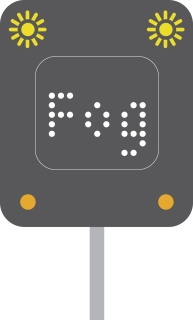
Our guide to motorway signs and signals covers the rest of the gantry, including the red X and variable limits that often come with poor visibility.
Can you flash your headlights to let someone go?
No. A flash of the headlights means one thing only: "I am here." It is a warning of your presence, like a horn, and it is not a signal to another driver to pull out, turn or cross.
The Highway Code, Rule 110: Flashing headlights. Only flash your headlights to let other road users know that you are there. Do not flash your headlights to convey any other message or intimidate other road users.
The other half of the rule matters just as much. If someone flashes at you, you have no idea what they meant by it, and they may not have seen the cyclist or pedestrian you are about to pull out in front of. Treat it as noise and make your own decision.
The Highway Code, Rule 111: Never assume that flashing headlights is a signal inviting you to proceed. Use your own judgement and proceed carefully.
A vehicle closing fast behind you and flashing its lights is a regular test scenario. The expected response follows from these rules: hold your speed within the limit, let it pass when it is safe, and do not be hurried or intimidated into anything.
What should you do if you are dazzled by headlights?
Ease off, and pull up if you have to. The Highway Code gives the same instruction for oncoming headlights at night and for low sun in your eyes, because the problem is identical: for a few seconds you cannot see the road.
The Highway Code, Rule 93: Slow down, and if necessary stop, if you are dazzled by bright sunlight.
If the dazzle is coming from behind, through your interior mirror, flip the mirror to its anti-dazzle setting rather than speeding up to get away from the lights. Speeding up to escape a vehicle that is too close is the one thing the fog rule above tells you not to do, and it applies just as well at night.
Which lights do you leave on when parked or broken down?
In fog, leave your parking lights or sidelights on if you have to park on the road at all. The Code calls parking on the road in fog especially dangerous, and prefers that you find somewhere off the road.
The Highway Code, Rule 251: Parking in fog. It is especially dangerous to park on the road in fog. If it is unavoidable, leave your parking lights or sidelights on.
In the ordinary case, stopping at the roadside means switching things off, not on: the engine, the headlights and the fog lights all go off before you leave the vehicle. A parked car with its fog lights blazing is a hazard of its own on a clear night. The separate question of whether a parked car needs lights at night depends on the speed limit of the road, which our speed limits guide covers under the 30 mph rules.
A breakdown follows the same logic. If your vehicle is causing an obstruction, warn other traffic with your hazard warning lights, and if it is dark or visibility is poor, keep your sidelights on so the vehicle can be seen.
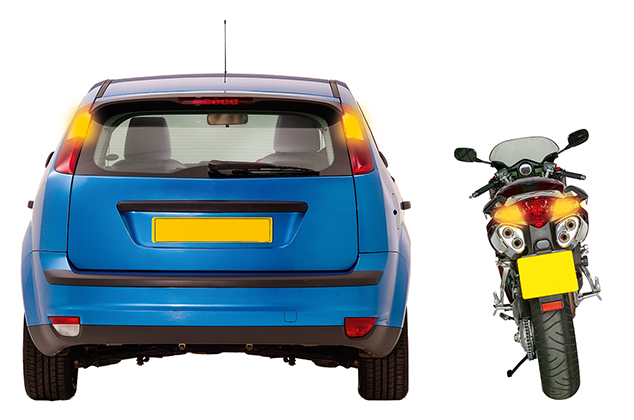
Lights in the theory test
Across the four official question banks in the Drivingo app, 72 questions turn on headlights, fog lights or dazzle: 26 in the car bank, 22 in motorcycle, 10 in LGV/PCV and 14 in ADI. The same facts come round in different wording:
- when fog lights may be used, and when they must be switched off
- why a motorcyclist rides on dipped headlights in daylight, and when drivers should use them in the daytime
- what a flash of headlights means, and what it does not
- what to do when you are dazzled, from in front or from behind
- which lights to leave on when parked or broken down in fog or in the dark
- what to check before setting off in fog
Several of these sit under safety margins and alertness, two of the hardest theory test topics. The fog questions lean on the same judgement as stopping distances: if you cannot see far enough to stop, you are going too fast for the conditions.
Drivingo drills every lights question in the official practice banks, with explanations that tie each answer back to its Highway Code rule, and the full Code reads offline inside the app. Download Drivingo and make fog lights a topic you get right without thinking.
Contains public sector information licensed under the Open Government Licence v3.0.