 DRIVINGO


Theory test
Driveway and Dropped Kerb Parking Rules: Highway Code 243, 248 and 249
Published
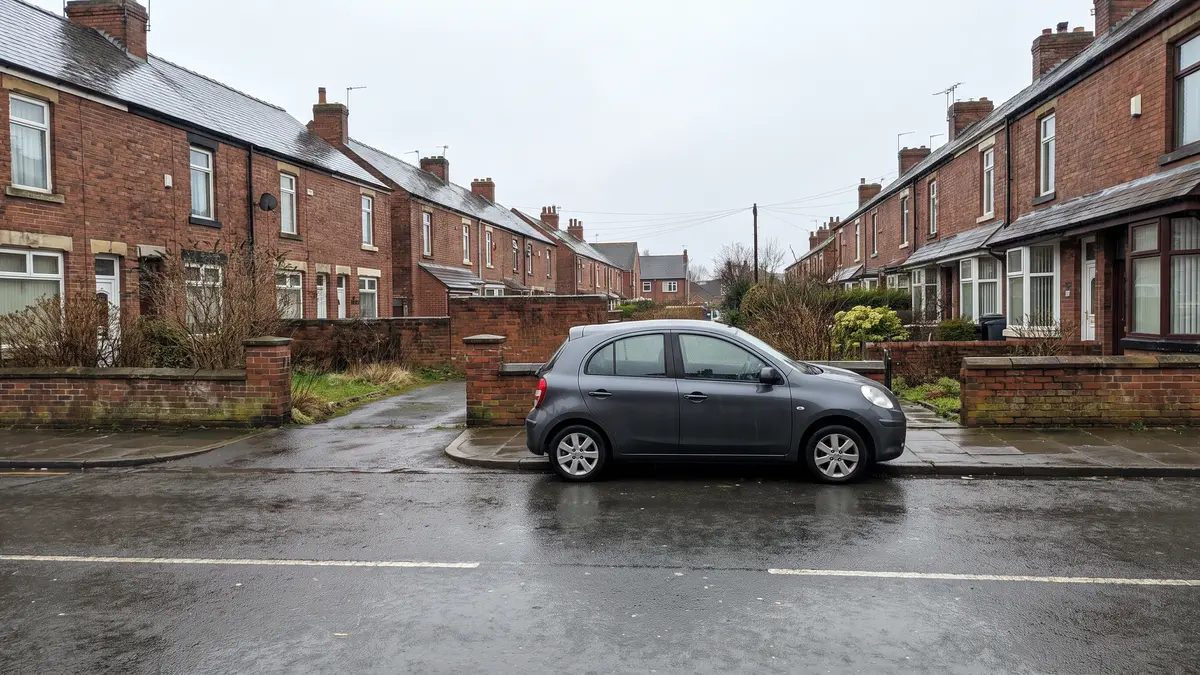
The Highway Code tells you not to park in front of the entrance to a property or where the kerb has been lowered, and in most of England and Wales the council can give you a penalty charge notice for it. Rule 243 is the one that covers driveways and dropped kerbs. On its own it is advice, a "do not" rather than a "MUST NOT", but separate parking law lets councils enforce it. In Scotland the Code itself says MUST NOT for kerbs lowered for pedestrians or cyclists.
Can you park across your own driveway? In England and Wales, usually yes. The law that bans parking at dropped kerbs has an exception for a car parked outside a home by the person who lives there, or with their consent, as long as the driveway is not shared. And Rule 248, the night parking rule people search for by number, says you must not park on a road at night facing against the traffic flow unless you are in a recognised parking space. Rule 249 adds the lights: on a road with a speed limit above 30 mph, your parking lights must be on.
What are the rules at a glance?
| Situation | What the Highway Code says | Law or advice? |
|---|---|---|
| Across someone else's driveway | Do not park in front of an entrance to a property (Rule 243) | Advice in the Code; councils can still issue a PCN |
| Across your own driveway | Same Rule 243 advice | Allowed in England and Wales if it is your home and not a shared driveway |
| At a dropped kerb for pedestrians or wheelchairs | Do not park where the kerb has been lowered (Rule 243) | Councils can issue a PCN; in Scotland it is law (MUST NOT) |
| On the pavement | Must not in London or Scotland; should not elsewhere unless signs allow it (Rule 244) | Law in London and Scotland, advice elsewhere |
| At night, facing the wrong way | Must not, unless in a recognised parking space (Rule 248) | Law |
| At night, on a road over 30 mph | Parking lights must be on (Rule 249) | Law |
The rest of this article is those rows in detail.
What does Rule 243 say about driveways and dropped kerbs?
It lists places where you should not stop or park, and both driveways and lowered kerbs are on it. Here is the full rule.
The Highway Code, Rule 243: DO NOT stop or park:
- near a school entrance
- anywhere you would prevent access for Emergency Services
- at or near a bus or tram stop or taxi rank
- on the approach to a level crossing/tramway crossing
- opposite or within 10 metres (32 feet) of a junction, except in an authorised parking space
- near the brow of a hill or hump bridge
- opposite a traffic island or (if this would cause an obstruction) another parked vehicle
- where you would force other traffic to enter a tram lane
- where the kerb has been lowered to help wheelchair users and powered mobility vehicles
- in front of an entrance to a property
- on a bend
- where you would obstruct cyclists’ use of cycle facilities
except when forced to do so by stationary traffic. In Scotland you MUST NOT double park or park anywhere the kerb has been lowered to help pedestrians or cyclists. Exceptions are allowed in limited circumstances. Law T(Scot)A part 6
Two entries in that list matter here: the entrance to a property, which is a driveway or a gateway with a lowered kerb across the pavement, and the kerb lowered for wheelchair and mobility scooter users, usually at a crossing point. The closing words give the only general exception: you are not breaking the rule when queuing traffic leaves you stopped there.
Notice the wording. The Code writes "MUST NOT" when a rule is backed by law and names the law under it. Most of Rule 243 is written as "DO NOT", so in England and Wales the Code is giving advice. The last paragraph is different: in Scotland, double parking and parking at a kerb lowered for pedestrians or cyclists are against the law, with only limited exceptions.
Is parking across a driveway illegal?
In most of England and Wales it can get you a fine from the council, even though the Highway Code only advises against it. Section 86 of the Traffic Management Act 2004 bans parking on the road next to a pavement, cycle track or verge that has been lowered to meet the road. The ban covers lowered kerbs that help pedestrians cross, help cyclists on or off the road, and let vehicles in and out of a driveway.
It applies in areas where the council enforces parking itself, which includes London. The council's enforcement officers issue a penalty charge notice (PCN), and you pay or challenge it with the council. GOV.UK's parking tickets page explains how.
The law has a handful of exceptions. The ones a driver is most likely to meet:
- parking wholly inside a marked bay, or anywhere parking is specifically allowed
- parking outside a home by the person who lives there, or with their consent, as long as it is not given for payment
- the emergency services on duty
- a short stop for a delivery or collection that cannot be made any other way
Stopping briefly to let a passenger in or out does not count as parking under this law, and neither does being held up by traffic.
Can I park across my own driveway?
In England and Wales, yes, as long as it is your home and the driveway is not shared. The exception in section 86 covers the person who lives at the property and anyone they let park there. It does not cover a driveway shared with a neighbour, because blocking it would trap their car too.
Some points still catch people out:
- The Highway Code advice still applies. Rule 243 does not carve out your own driveway. It is advice, so you will not be fined for it alone, but in a theory test answer the rule is the rule.
- Other restrictions still apply. If there are double yellow lines outside your house, the driveway exception does not let you wait on them. Our guide to yellow and red lines covers each marking.
- Your car must still be on the road, not the pavement. Parking with two wheels up on the pavement in front of your own driveway is pavement parking, covered next.
What is the difference between London and the rest of the UK?
For driveways and dropped kerbs, London follows the same council-enforced ban as the rest of England and Wales. The bigger difference is pavement parking.
The Highway Code, Rule 244: You MUST NOT park partially or wholly on the pavement in London or Scotland. Exceptions are allowed in limited circumstances. You should not park partially or wholly on the pavement elsewhere unless signs permit it. Parking on the pavement can obstruct and seriously inconvenience pedestrians, people in wheelchairs or with visual impairments and people with prams or pushchairs. Law GL(GP)A sect 15 & T(Scot)A part 6
In London and Scotland, parking with even two wheels on the pavement is against the law unless signs allow it. In the rest of England and in Wales, the Code says you should not, but it is not a legal ban in itself. Councils can still use their own signed restrictions, so local signs always win. Scotland goes furthest overall: its law covers double parking, pavement parking and parking at kerbs lowered for pedestrians or cyclists.
Why do dropped kerbs for pedestrians matter so much?
Because a car parked across one can leave a wheelchair user, a blind person or a parent with a pushchair with no safe way to cross. A lowered kerb is often the only step-free point on a stretch of pavement. Many have tactile paving, the raised studs that tell a blind or partially sighted person they are at a crossing point. If a car blocks it, the next one may be a long way back, or the person has to go out into the road between parked cars.
That is why the Code groups lowered kerbs with school entrances, bus stops and junctions: places where a parked car puts someone else at risk. The hierarchy of road users puts the same idea in general terms. Drivers carry the greater responsibility, and pedestrians and wheelchair users are the most at risk.
What does Rule 248 say about parking at night?
You must not park on a road at night facing against the traffic flow, unless you are in a recognised parking space. It is a legal requirement, so the Code writes it as MUST NOT.
The Highway Code, Rule 248: You MUST NOT park on a road at night facing against the direction of the traffic flow unless in a recognised parking space. Laws CUR reg 101 & RVLR reg 24
The reason is your reflectors and lights. Parked on the correct side, facing the same way as the traffic, the red rear reflectors face the drivers coming up behind you. Parked on the wrong side, a driver sees your white headlights and may think your car is moving towards them. In a one-way street you may park on either side, because both sides face the traffic flow.
Rule 239 gives the same advice for any time of day: do not park facing against the traffic flow, and pull in as close to the side as you can.
When do I need parking lights at night?
On any road or lay-by with a speed limit above 30 mph. Rule 249 makes parking lights a legal requirement there.
The Highway Code, Rule 249: All vehicles MUST display parking lights when parked on a road or a lay-by on a road with a speed limit greater than 30 mph (48 km/h). Law RVLR reg 24
On roads with a limit of 30 mph or less, a car can be left without lights if it is parked in the right place. Rule 250 sets the conditions.
The Highway Code, Rule 250: Cars, goods vehicles not exceeding 2500 kg laden weight, invalid carriages, motorcycles and pedal cycles may be parked without lights on a road (or lay-by) with a speed limit of 30 mph (48 km/h) or less if they are:
- at least 10 metres (32 feet) away from any junction, close to the kerb and facing in the direction of the traffic flow
- in a recognised parking place or lay-by.
Other vehicles and trailers, and all vehicles with projecting loads, MUST NOT be left on a road at night without lights. Laws RVLR reg 24 & CUR reg 82(7)
Put the three rules together and a car parked overnight on a 30 mph street needs no lights if it is close to the kerb, facing the traffic flow and at least 10 metres from a junction, or in a recognised parking place. Move the same car to a 40 mph road and the parking lights must be on. Larger vehicles, trailers and anything with a load sticking out always need lights at night, whatever the speed limit.
The fog lights and dipped headlights guide covers which lights to use while you are driving.
Driveway and night parking in the theory test
Across the four question banks in the Drivingo app, 15 questions ask about parking at night, parking lights, the pavement or a property entrance: 5 in the car bank, 4 in motorcycle, 4 in LGV/PCV and 2 in ADI. The patterns repeat:
- which side of the road you may park on at night, and when the other side is allowed
- the speed limit above which parking lights must be left on
- where a parked car would block access to a property
- what the sign allowing parking on the pavement or verge means
- where a lorry or bus may be parked at night without lights
The lorry and bus banks lean on lights, because large vehicles never get the 30 mph exemption that cars do. In the car questions, the tempting wrong answers to the night parking question are usually about light: a bright street or your own lights. The rule is about the direction you face, not about how well lit you are.
Drivingo drills every parking question in its practice banks, with explanations that tie each answer back to its Highway Code rule, and the full Code reads offline inside the app. Download Drivingo and make parking rules a topic you get right without thinking.
Contains public sector information licensed under the Open Government Licence v3.0.