
Theory test
Roundabout Rules: Who Has Priority and Which Lane to Use
Published
The core roundabout rule is simple: give priority to traffic approaching from your right, unless signs, road markings or traffic lights tell you otherwise. Almost everything else about roundabouts follows from that one rule plus good lane discipline.
Roundabouts supply some of the most commonly missed theory test questions, because the signalling rules are precise. Here they are in full.
Who has priority at a roundabout?
Traffic from your right, already on or entering the roundabout. You give way to it; you don't stop dead unless you need to. If the way is clear, keep moving.
The Highway Code, Rule 185: When reaching the roundabout you should
- give priority to traffic approaching from your right, unless directed otherwise by signs, road markings or traffic lights
- check whether road markings allow you to enter the roundabout without giving way. If so, proceed, but still look to the right before joining
- watch out for all other road users already on the roundabout; be aware they may not be signalling correctly or at all
- look forward before moving off to make sure traffic in front has moved off.
Watch the vehicle ahead of you too. Plenty of rear-end bumps happen at roundabout entries because the driver behind assumed the car in front had gone.
How should you approach a roundabout?
Use all the information on the approach: signs, traffic lights and lane markings, and get into the correct lane early.

The Highway Code, Rule 184: On approaching a roundabout take notice and act on all the information available to you, including traffic signs, traffic lights and lane markings which direct you into the correct lane. You should
- use Mirrors – Signal – Manoeuvre at all stages
- decide as early as possible which exit you need to take
- give an appropriate signal (see Rule 186, below). Time your signals so as not to confuse other road users
- get into the correct lane
- adjust your speed and position to fit in with traffic conditions
- be aware of the speed and position of all the road users around you.
Which lane and signal for each exit?
This is the part the theory test loves. Unless signs or markings say otherwise:
Turning left (first exit):
- Signal left on approach
- Approach and stay in the left-hand lane
- Keep signalling left through the exit
Going straight ahead (intermediate exit):
- No signal on approach
- Use the left-hand lane unless markings say otherwise
- Signal left after you pass the exit before the one you want
Turning right or going full circle (later exits):
- Signal right on approach
- Approach in the right-hand lane
- Keep right on the roundabout, then signal left after passing the exit before yours
The pattern behind all three: your exit signal is always a left signal, given just after the exit before the one you're taking. That timing tells waiting drivers exactly where you're leaving.
Who should you watch out for on a roundabout?
The Highway Code, Rule 187: In all cases watch out for and give plenty of room to
- pedestrians who may be crossing the approach and exit roads
- traffic crossing in front of you on the roundabout, especially vehicles intending to leave by the next exit
- traffic which may be straddling lanes or positioned incorrectly
- motorcyclists
- long vehicles (including those towing trailers). These might have to take a different course or straddle lanes either approaching or on the roundabout because of their length. Watch out for their signals.
Cyclists and horse riders may legally stay in the left lane even when turning right, and long vehicles may straddle lanes because they need the room. Give them space rather than holding them to car rules.
How do mini-roundabouts work?
The same priority rule applies: give way to traffic from your immediate right. Two differences matter:
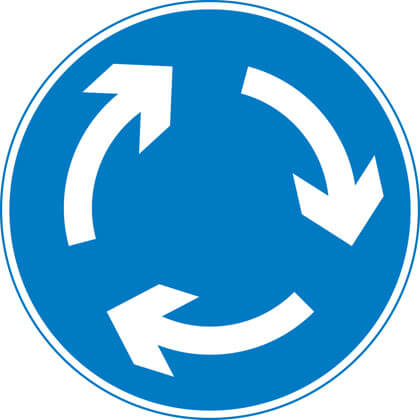
- You must pass around the central markings; driving over the painted circle is only permitted for large vehicles physically incapable of avoiding it
- There's much less time and space to signal, so decide your exit before you arrive
At double mini-roundabouts, treat each one separately and give way to your right at each. Complex junctions built from several mini-roundabouts work the same way: one at a time.
Roundabouts in the theory test
Expect questions on the priority rule, the correct signal timing for each exit, mini-roundabout markings and vulnerable road users. They're answerable from the rules above, and the signalling pattern is worth learning cold because it comes up in the practical test too.
Drivingo drills every roundabout question in the official practice bank, with explanations that connect each answer back to the rule, and mock tests that show whether the marks stick under pressure. Download Drivingo and make junctions your strongest topic.
Contains public sector information licensed under the Open Government Licence v3.0.